Tag Archive for: Uncharted Moments

I always thought this space would hold stories—of life, of music, of family, and the small graces of finding our way together. I thought the hardest posts would be the ones I wrote when each of my parents passed. 

I was wrong.

This is the post I never wanted to write.

It’s about Carmen.

It’s about disease.

And it’s about love, stubborn as a river, carrying us even now.
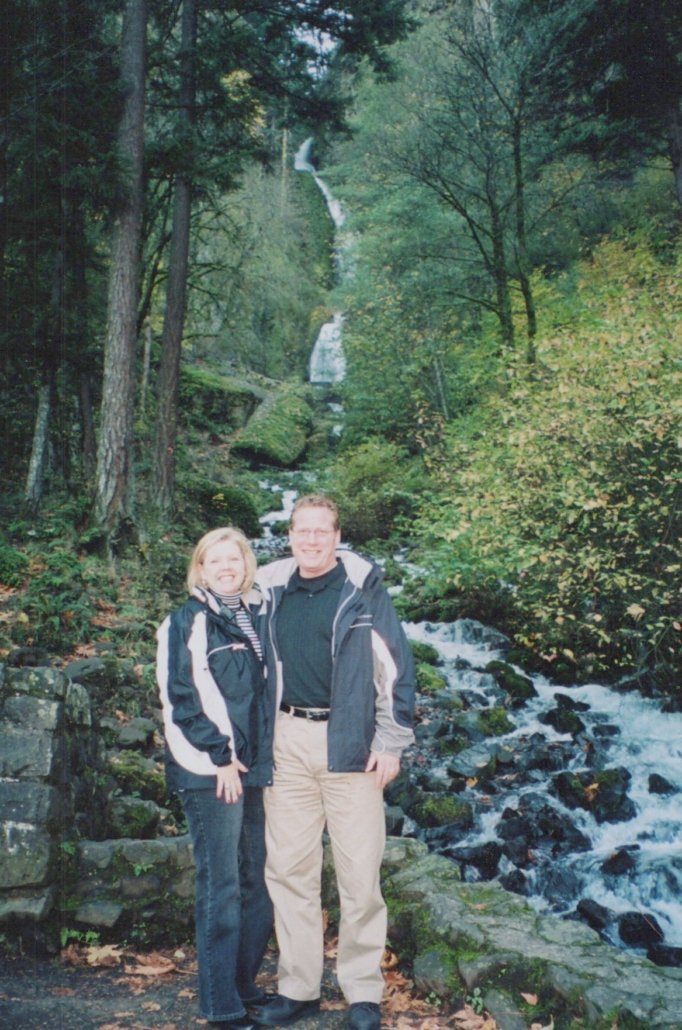
 

Carmen and Jeff standing together near Multnomah Falls, surrounded by forest and flowing water.

Carmen and I at Bridal Veil Falls — early in our journey together.

How We Got Here

For a long time, Carmen called it “the fishbowl.” Dizzy spells, balance that wobbled, handwriting that started to lean and stutter. We visited doctors who looked thoughtful and then not. Finally, someone said, “You need to go to the Cleveland Clinic or Mayo.”

We chose Cleveland.

A neurologist pulled up the MRI, leaned toward the screen, and said, “Your cerebellum impresses me.”

I tried to joke. “We don’t think we want her cerebellum to impress you.”

He shook his head. “No. You don’t.”

The words that followed arrived like hail: Multiple System Atrophy, cerebellar type (MSA-C). Degenerative. No treatment. No cure. Average timeline measured in years you can count on one hand, maybe both.

We rode home in silence that wasn’t empty, just heavy. You know the feeling if you’ve been there—the sound the soul makes when the floor drops out.

Since then, we’ve chased second opinions and third confirmations. We’ve learned new vocabulary we never asked for: rollator, autonomic, orthostatic, and anticipatory grief. We’ve learned how bodies can surprise you, even when you love them fiercely. We’ve learned to grieve in real time.

What Daily Looks Like Now

Carmen once crossed a room the way sunlight crosses a wall—quiet, sure, taking everything with her. Now she uses a rollator and footsteps that shuffle. We purchased a powered wheelchair for outings that require more steps than her body can handle. 

Her voice—the one that used to sing through a room without trying—has a tinny edge now, syllables arriving in little bursts, breath paying a toll at every turn. Restaurants are hard. Parties harder. Phone calls require a kind of gymnastics the larynx didn’t sign up for.

She used to be our chef, the hostess who could coax a holiday into happening with nothing but flour, butter, and a list she wrote in that elegant hand I loved so much. Now the kitchen is a maze. The microwave is a mountain.

Then there are the invisible things: blood pressure that drops fifty points when she stands; temperature regulation that forgets its job. These are the quiet alarms we don’t like to talk about. They remind us what’s still to come.

And still—please hear me—she is here. She is Carmen. Grace in a human frame. Humor that keeps showing up. Dignity that refuses to yield the field.

Sacred Ordinary

We’ve always talked about sacred places—how holiness can be a cathedral, yes, but more often it’s a porch. These days, the sacred shows up at 5:30 p.m. on ours, when we drag two chairs into the soft light and call it cocktail hour. Lemonade or tonic for her most nights. It doesn’t matter. The ritual is the sacrament.

Grandkids swarm the house and bend the day toward joy. Carmen can’t chase a ball now, but she can play a rousing game of Uno. She can say yes to makeup sessions and TikTok cookie recipes. They orbit her like she is gravity—because she is. Little Hayden loves to ride “gamma’s car”—her wheelchair. 

We binge-watch shows side-by-side. We sit with squirrels. We read old cards and the little notes couples write when the world still feels endless. We touch what time can’t steal.

Sacred isn’t loud.

Sacred is steady.

The Love Story I Didn’t Know I Was Writing

When I began the book that has become Uncharted Moments, I thought I was writing about Lewis and Clark—rivers, road miles, history’s big arc. Somewhere between Fort Clatsop and the stretch of the Natchez Trace near Hohenwald, Tennessee, I understood: I was writing about us. About the woman beside me with the unflappable kindness and the eyes that see both what is and what could be.

She isn’t my Sacagawea. She is — and always will be — my Lewis. The one with a compass lodged somewhere behind the ribcage, the one who would say “we proceed on” with a half-smile and mean it.

I used to say the river taught me how to listen. Carmen taught me how to arrive.

What I’m Learning as a Caregiver

I closed a business I loved. We traded the retirement we imagined—long flights, new stamps in the passport—for hallways and ramps and a different kind of itinerary. I help her into the car. I rub oil into her legs after a shower. I learn the choreography of pillboxes. I fold laundry at 10 p.m. and feel, strange as it sounds, lucky to be the one folding.

Love keeps changing its job description and then handing me a fresh badge. It is less about grand gestures and more about staying. Less about perfect words and more about the breath you take together on a Tuesday when the kitchen is quiet, and there’s a vase of grocery-store flowers trying their best.

There are hard days. Anger with no clean address. Tears that don’t explain themselves. The fear that comes at 3:17 a.m. and wants to explain everything.

But there is also this: we are here. We are not alone. Family shows up. Friends show up. Neighbors carry casseroles and joke about deer in the tomatoes. Nurses and therapists move through our lives like angels of mercy.

If you’ve been praying for us, texting, calling, bringing soup—thank you. You are holding a corner of the map.

Reading the Story More Fully

Years ago, while we were following the Lewis & Clark Trail, Gerard Baker’s voice at the Filson on Main turned our heads and hearts toward a wider story—one that didn’t erase heroism but insisted on context, cost, and a chorus of voices. That practice—of looking again, listening longer—has become a way of life here, too.

Illness wants to shrink the world to symptoms and schedules. We keep choosing to read the margins. To notice the parts that don’t fit neat lines. To honor the whole of a person, not just the chart.

Carmen is not her diagnosis.

She is the builder of a family that didn’t come by blood but by love.

She is the smile that made holidays ring.

She is the woman who, when I dragged us waist-deep into a stream for citizen-science training, looked up at passing teenagers in waders and said, “Be careful who you fall in love with—this could be you,” and then laughed like she’d just invented sunlight.

What I Ask (and What I Don’t)

I don’t have a list of action items. We’re not fundraising or campaigning. We’re learning to let people love us in practical ways and to say yes more often than our Midwestern instincts allow.

If you want to help, the best gift is presence—notes, stories, photos, a memory of Carmen being Carmen. Tell us the small thing you remember: the casserole she brought, the way she made your child feel seen, the time she quietly fixed something no one else noticed was broken. Those are the strands that braid a life.

And if you’re a caregiver or you love one, I see you. You are doing holy work in grocery aisles and waiting rooms. You are building cathedrals out of Tuesday afternoons. Keep going. Breathe. Ask for help. Say yes.

Confluence

There’s a fifteen-star, fifteen-stripe flag near my desk—the one Carmen gave me that flew over Fort Clatsop on my birthday. I look up at it when the house goes still. It feels like a kind of tenderness, mast and map both. It reminds me that the real expedition was never the miles under our wheels. It was the passenger seat beside me.

MSA-C is the terrain we never wanted to encounter. It is also not the whole country. The map is bigger than the diagnosis. There are porches still, and grandkid giggles, and movie nights where nothing much happens except that we are together and the lamp makes a soft circle on the rug.

We are navigating a stretch of river the charts call conjectural—the old word for places not yet fully known. The Corps of Discovery used it for gaps they’d fill in later. I like that. Not denial, just humility. A willingness to proceed without pretending certainty we don’t have.

So here we are. Proceeding. On.

If you pray, pray. If you remember, share. If you love us, keep doing what you’ve been doing. We’re grateful for every hand on the rope.

And if you’re reading this because you’ve been walking your own uncharted season: you’re not alone. The river knows the way. Love knows the way. Sometimes the bravest thing is to sit on the porch, hold the hand that has held yours, and let the evening light do what it does—turn the ordinary into something hallowed.

We proceed on.
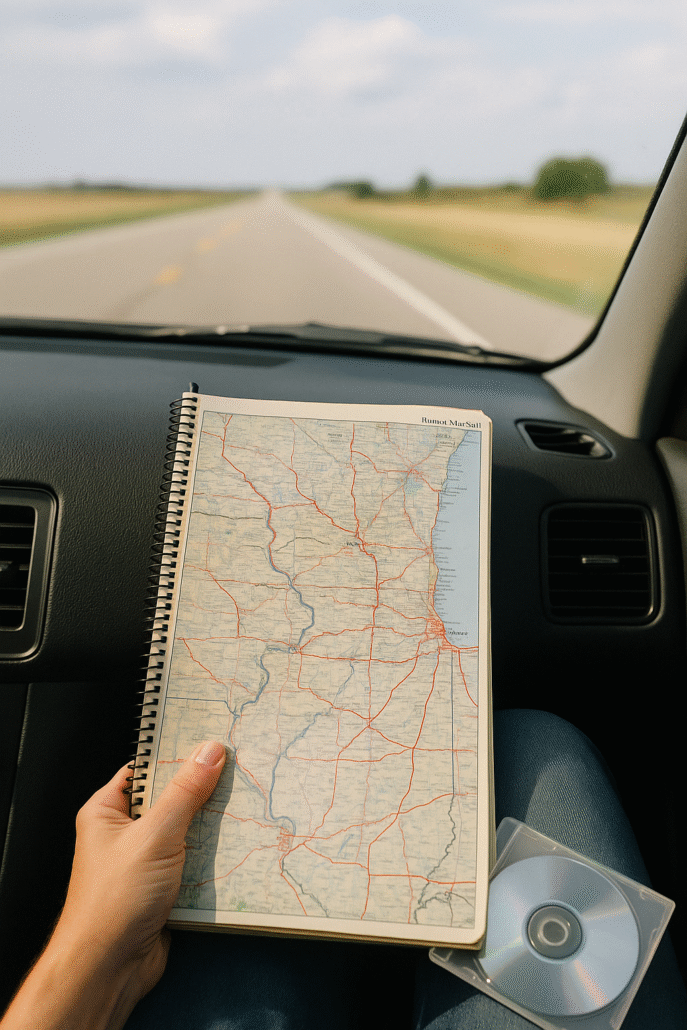
A woman’s hand holds a worn Rand McNally road atlas open on her lap in the passenger seat of a car, sunlight spilling across the map as an empty two-lane highway stretches ahead. A CD case rests beside her, hinting at the soundtrack of the journey.

From paper to pixels, our favorite navigation system was still analog — Carmen and her atlas.

How the world changed beneath our wheels.

I was sorting through a box of old trip photos the other day — glossy 4×6 time capsules from a different century — when it hit me. Uncharted Moments isn’t just a story about where we went. It’s also about how the world changed beneath our wheels.

As Carmen and I followed the Lewis and Clark Trail, the technology around us evolved almost as quickly as the landscapes we drove through. What started as paper maps and mix CDs became satellite-guided routes, digital playlists, and cloud-backed memories.

It’s funny: while we were tracing the past, the future was quietly catching up to us.


Finding Our Way

In those early years, “navigation” meant one thing — MapQuest printouts. Six or seven pages of turn-by-turn directions so detailed they could’ve guided a lunar landing.

Carmen would sit in the passenger seat, papers spread across her lap, reading aloud like an auctioneer:

“Take ramp toward I-70 West. Go 0.1 miles. Merge onto I-70 West. Go 23.4 miles.”

Halfway through the second page, she’d look up and sigh.

“Didn’t we just do that?”

She wasn’t wrong. MapQuest had trust issues. It narrated everything. Getting off the ramp, getting back on, continuing straight. God help you if you missed a turn; by the time you found your place again, you’d already reached the next state.

Then came Microsoft Streets & Trips, which let us print maps with tidy flags and pastel highlights. I spent hours fine-tuning those routes — optimizing waypoints like I was planning a corporate network migration.

Eventually, we graduated to the Garmin GPS, that small oracle on the dashboard. “Recalculating…” became part of our soundtrack. When we upgraded to a BlackBerry with GPS, it felt like we were driving inside The Jetsons.

And yet, through all of it, Carmen never let go of her Rand McNally Atlas. The maps for each state were folded, worn, and lined with her notes — our analog breadcrumb trail.

Her skill with those maps bordered on the mystical. Once, using nothing but Granny’s journal and her atlas, she located the exact spot of my grandmother’s childhood farmhouse.

“If it’s four and a half miles northwest of here, and four northeast of there,” she said, tracing her finger over Pierce County, “then it must be right… here.”
Moments later, the farmhouse appeared on the left.

You don’t get that kind of magic from a GPS.


The Soundtrack of the Road

Our soundtrack evolved just like our maps.

In the beginning, it was FM radio — finding a station, losing it to static, scanning for something new. Carmen could sense a signal fading like a storm front.

We carried a massive CD binder, with Carmen as our DJ—the Stones, Clapton, Seger — the soundtrack of a thousand miles. On one trip, Sirius launched an all-Stones channel, and we made a game of it: we’d try to guess whether the next song would be by the Rolling Stones.
Of course, it always was. And every time, we’d laugh like kids.

Satellite radio felt like a revelation — hundreds of channels, coast to coast, no static. Later came streaming: Pandora, then Spotify, each algorithm learning our moods, our memories, our mile markers.

Still, I miss the surprise of radio. That serendipity when the perfect song just finds you on the open road.


Capturing the Moment

If navigation told us where we were going, and music carried how we felt, then photos preserved what we saw.

Our first trips were shot on 35mm film — 24 exposures per roll, every click a small gamble. We’d drop them at Walgreens and wait days, sometimes weeks, to find out if we’d actually captured the hawk, the river, the laugh.

Then came the digital camera, with its tiny 2×2 screen that gave you just enough feedback to think, maybe.

Later, our hard drives became overloaded with folders named “Trip3_FINAL” and “Trip3_REALLYFINAL.” We took more photos than we could ever sort — tens of thousands of them. Carmen was the master captioner, turning each image into a story: equal parts wit and wonder.

Now, our phones do it all — cameras sharper than anything we dreamed of thirty years ago, every image backed up to the cloud within seconds. Convenient, yes. But sometimes I miss the feel of a print — the weight of memory in your hand.


Then and Now

Somewhere between MapQuest and Google Maps, FM and Spotify, 35mm and the cloud, our story unfolded — not because of the technology, but in spite of it.

We found our way together. We learned to listen. We captured the moments that mattered.

The tools changed. The wonder didn’t.

And after all those years as a CIO chasing the next upgrade, I’ve realized something simple:

Sometimes the best innovation is still just looking out the window — together — and saying, “Proceed on.”

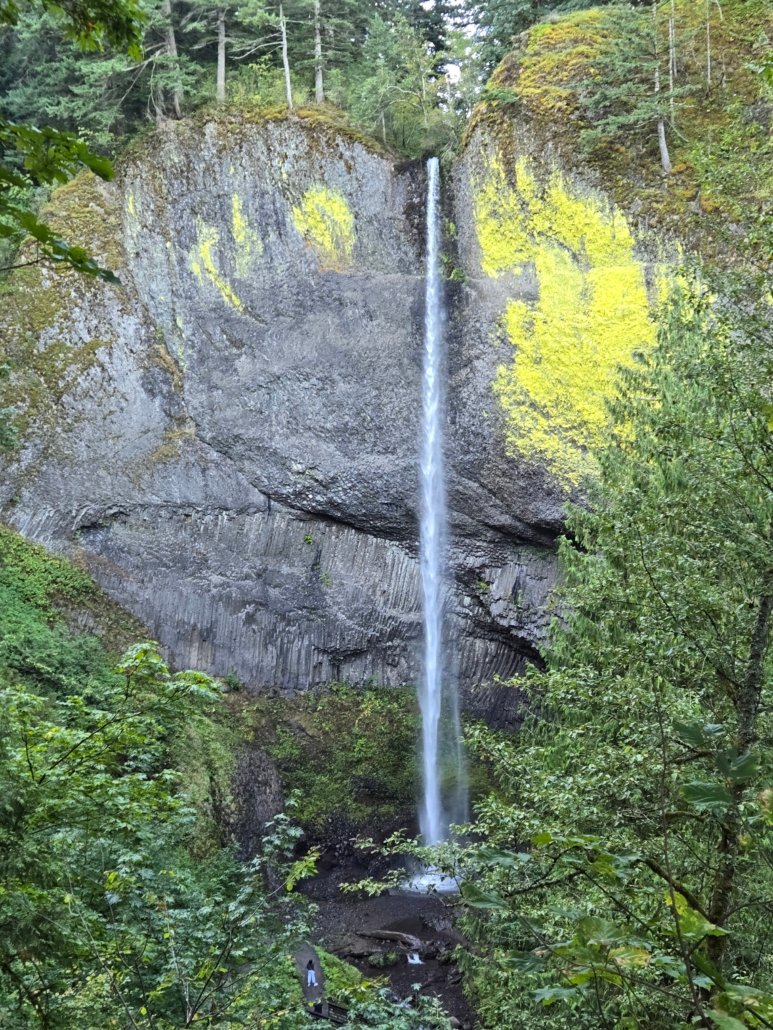
Lower Latourell Falls, a single ribbon of water carving basalt for centuries.

I drove east from Skamania Lodge this morning, the Columbia River off my shoulder and the day so clear it almost rang. September-blue sky. Sun bright enough to make the river flash like a blade. My grandson, Jordan, told me Friday with precision: autumn arrives Monday at 2:19 p.m. Eastern. Out here, that’s 11:19 a.m.—still ahead of me as I wound into the Gorge toward Latourell Falls.

Autumn carries a certain somberness for me, a quieting. Not sadness exactly—more like the sound turns down so you can hear what’s underneath. Maybe that’s why I felt pulled to the trail. I wanted to walk into the season rather than let it arrive without me.

At the trailhead, a tour group had just gathered for the lower falls. Laughter, a few wool caps, an airhorn of enthusiasm. I smiled, stepped aside, and chose the upper falls first—the steeper, quieter way. I wasn’t looking to be alone, exactly; I was looking for the kind of company a forest keeps.

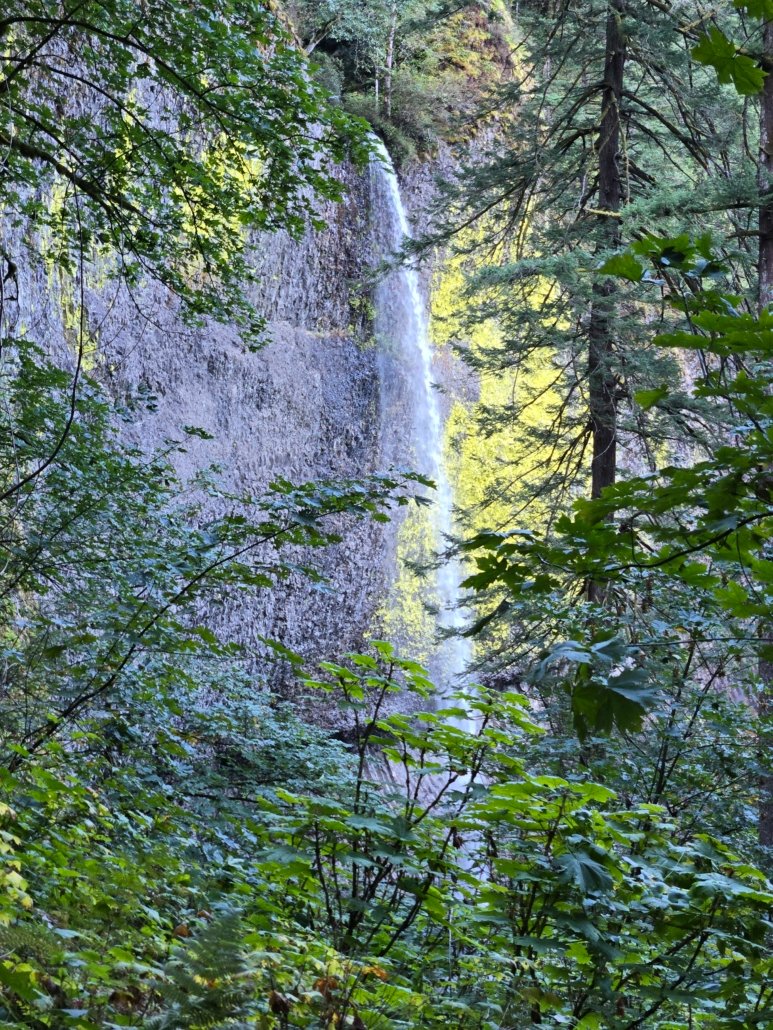
Within a few minutes, the Gorge did what it always does—it closed the door on the highway and pulled me into its own weather. Ferns stitched the ground, their fronds beaded with last night’s damp. Moss softened every trunk and limb as if the trees had been given green coats for the season ahead. The air smelled like earth made new, like stone rinsed clean. Even as I climbed, it felt like a descent into a sanctuary—cooler with every turn, light growing spare and slanted. Morning clouds had pooled in the ravine and hung there, a gauzy haze caught in the evergreens. Some places down here probably never see direct sun. They don’t need it. They glow on their own.

I thought of the Corps of Discovery—how often I do. Did Lewis or Clark, or any of their men, step into a bowl of forest like this and go quiet because there was nothing else to do? The Gorge isn’t the Missouri, but wonder travels well. The particulars change—rock, water, tree—but the feeling is the same: smallness that enlarges you.

This place surely carried another name, spoken in a language older than maps.

I also thought of the Indigenous peoples who walked this land long before Lewis and Clark, long before any of us. What drew them to these falls? Did the sound carry meaning, the mist hold stories, the basalt cliffs serve as markers? Surely this place, with its power and beauty, carried a name of its own—a name rooted in language older than English, older than the maps I’ve studied. I wondered what ceremonies, what moments of gathering or prayer, may have happened on these same stones where I now stood, a guest in their homeland.

And then, as always, I thought of Carmen. I miss her in places like this with an ache that’s both tender and grateful. I wish she could see what I’m seeing, breathe this somewhere-between-summer-and-fall air, hear the steady hush of water working the canyon. She has a way of noticing beauty that makes my noticing better. It’s one reason I’m writing Uncharted Moments—to gather these places and hours, to honor the way they’ve shaped us, to invite readers into the country we fell in love with (despite its flaws), the land itself and the people whose homelands these are, and the love story that carried us along.

That’s the challenge I carry up trails like this: how to translate a feeling into words without dulling its edge. How to write a scene so true you can smell the moss and taste the spray. How to talk about the wonder that arrives unannounced and refuses to be photographed. I want Uncharted Moments to do that—to rise, chapter by chapter, into a kind of crescendo that isn’t noise but resonance. Not louder, truer.

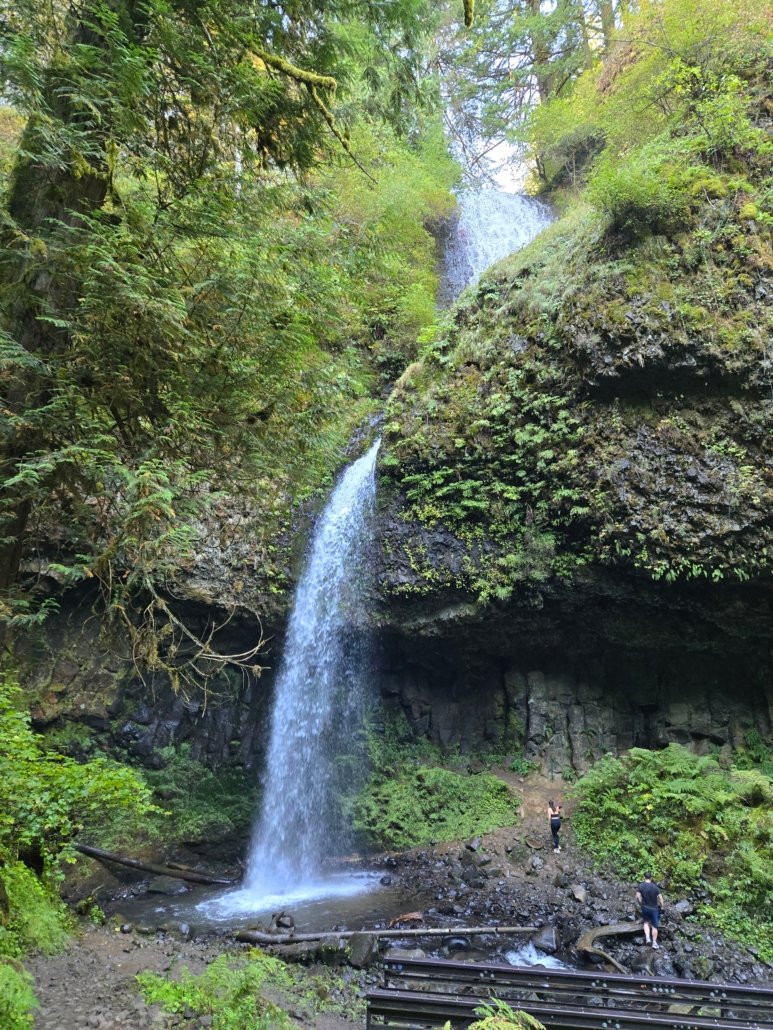
The path leveled, and the sound of water shifted from rumor to presence. At a break in the trees, the upper falls appeared—veil and plunge, a white ribbon slicing the basalt. I stood and let time do what it does in front of moving water: lengthen and loosen. You don’t measure a waterfall; it measures you.

On the way down, I rejoined the lower trail, and the crowd’s energy returned in bits and pieces—footsteps, voices, the happy clatter of trekking poles. I rounded a bend just as a woman—seventies, camera in hand, careful on the narrow path—rounded from the other side. She looked up, caught her first sight of the lower falls, and her face opened. It was all there at once: surprise, delight, reverence. A smile that belonged equally to her and to the water. Pure joy. Pure “oh my God.”

I wish I had taken a picture. I didn’t. The moment kept moving, as it should. But it stayed with me, because that expression—hers—was the mirror I needed. That’s what I’m trying to write toward. Not a catalog of places, not a ledger of miles, but that spark of recognition when beauty strikes and we say, without words: yes.

If you’ve followed my work for a while, you know how often I return to rivers and trails, to the Lewis & Clark story that first sent Carmen and me west, to the way travel can teach you to listen. You also know my bias: the land is a mentor if we let it be. It slows you down, insists on your senses. In a ravine like Latourell’s, you start to notice things you’d otherwise miss—the way the spray cools the air twenty paces before you see the falls, how moss drinks light, how a single cedar can hold the smell of a decade. The world doesn’t have to shout here. It just is, and that’s enough.

I think that’s why autumn carries that somberness for me. Not because something ends, but because the world invites you closer. Leaves turn, not to be dramatic, but to mark the shift. The river lowers. The light sharpens. The calendar clicks forward—11:19 a.m. Pacific, the equinox arrives—and whether you’re ready or not, the season proceeds on.

Driving back west toward Skamania, the sun a little higher, I thought about that smile again and what it asked of me as a writer, a husband, a grandfather. Pay attention. Say what you mean. Carry the moment carefully and then set it down so others can pick it up. Uncharted Moments isn’t a museum of our travels; it’s a living room. I want readers to walk in, sit with the stories, and feel the same quiet joy I felt on that trail—or the grief we’ve carried, or the stubborn hope that keeps us going. I want them to meet Carmen on these pages the way I’ve met her on a hundred trails and riverbanks: steady, brave, eyes bright at the edge of a view.

The Gorge didn’t try to make a speech today. It offered a handful of simple things: cold air, wet stone, trees in their green coats, a waterfall doing its work, a stranger’s face turned to wonder. That’s plenty. That’s abundance. And it’s enough of a map for me to keep writing, to keep trusting that the right words will arrive, as seasons do, right on time.

Autumn is here—my grandson’s clock confirms it. The light is already different. I’m grateful for a morning that let me walk into it on purpose, east from Skamania, up into the hush, and back again with one small, perfect reminder: joy is often just around the bend, waiting to be reflected.

Beauty reflected back in the faces of those who find it.

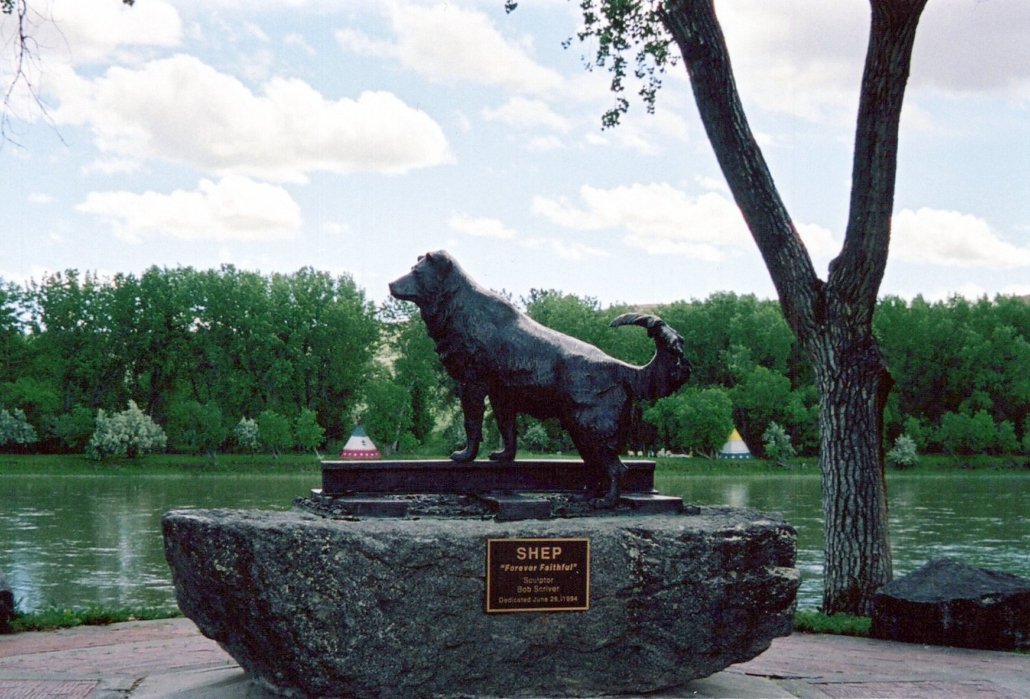
Shep - Patiently Waiting for His Master's Return

Shep – Ever Vigilant


Fort Benton wears the river like a well-earned badge. The Missouri slides past the levee with that steady, old-timer confidence—no hurry, no apology—shouldering stories you can feel even if you can’t name them. We parked, stretched road miles out of our backs, and did what we always do when we arrive anywhere along the trail: we listened. Not just with our ears, but with that other sense you learn on the water—the one that asks, What happened here, and who’s still holding the memory?

You don’t have to look far in Fort Benton. The brick storefronts, the iron bridge, the museum signs—they all point to lives stacked over lives. And there, near the river, is the town’s quiet heartbeat cast in bronze: Shep. Head lifted, ears set to a frequency I swear you can almost hear if you stand there long enough. The statue is beautiful, yes, but more than that, it’s attentive. It watches the place like a promise.

We learned the story—most visitors do—a dog and a depot. Loyalty stretched across too many days. Waiting that outlived an answer. Even if you only catch it in passing, the story tugs something in you that’s older than words. But that afternoon, the pull landed somewhere personal I hadn’t noticed before.

We read the plaque, circled the statue, and let the river do its slow work. The trick with places like this is to resist the urge to rush. You let your mind walk past the easy facts and settle into the grain. And in that space, Shep became less a legend and more a lens. Who’s keeping watch while we cross? Who’s marking the thresholds we don’t even recognize as thresholds until we’re on the other side?

A Second Shep

Back home, weeks later, I wrote the Fort Benton pages. I tried to capture the light on the water and the way that bronze posture lifted the afternoon into something like prayer. I tucked the scene among the rest of Leg 8—the miles, the small talk, the way a town on a river is never just a town. Then I slid the draft to Carmen.

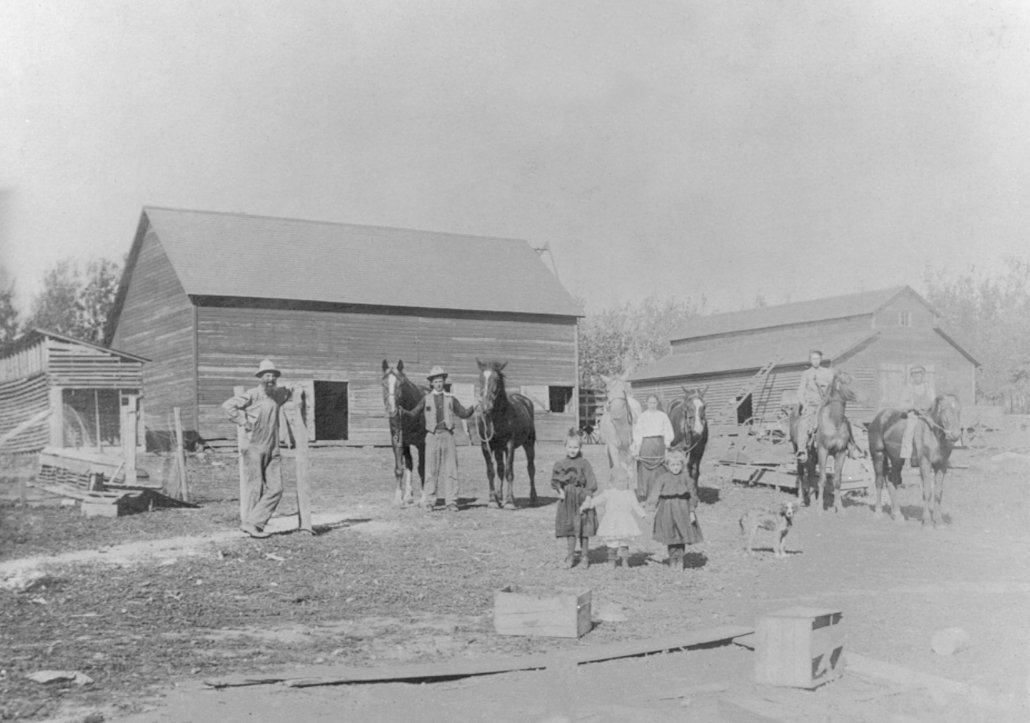
Hickey Family circa 1909

Hickey Family circa 1909 – Shep Front Right

Carmen proofreads like a cartographer—pencil steady, eyes tuned to terrain. She loves me enough to circle what’s true and underline what needs another pass. She also listens for echoes I miss. She was a few pages in when she looked up, soft smile, head cocked just a hair.

“You know your Granny’s dog was named Shep, too… right?”

The room did that slow-focus thing. I could hear the pencil roll to a stop. “What?”

“Your Granny’s farm dog,” she said, like we were both standing there in the yard already, like we’d just heard the back porch screen door slap. “Shep—it’s in her journals.”

There it was. Two Sheps, one in bronze beside the Missouri and one running fencerows in stories I grew up hearing without really hearing. A simple name becomes a through-line you can trace with your finger across a map of years. You think you’ve written a scene about a statue, and it turns out you’ve been writing about keeping watch your whole life.

I can see him now in the mind’s film—my Granny’s Shep—tan, with a white face blur at the edge of chores, tail sweeping the dust of a long afternoon. Whistle and he comes. Whisper and he hears. That’s what a shepherd does, even on a farm nowhere near a flock: he tends the threshold. He tells you when a stranger is coming up the lane. He walks with you to the barn at dusk and back to the house in the blue wash of evening. He is presence in motion.

Presence

And that’s what Fort Benton’s Shep felt like to me: presence. Not just the story tourists trade on the levee, but the way a place remembers for you when you’ve forgotten. The statue doesn’t just honor a singular dog; it blesses the job all guardians have—human or canine, living or gone—to stand at the crossings and keep an eye on us as we pass.

Carmen has always been the one to catch these threads. She did it in Paris when a bell peal turned “just friends” into something is happening. She did it in Louisville, at Mulberry Hill, when a small chain-link fence around forgotten graves felt louder than the big history down the road. She does it daily in our living room with a pencil poised over my prose. She doesn’t preach; she notices. Then she hands me the noticing like a found coin: This matters. Don’t walk past it.

Her Shep comment sent me back to the manuscript. I didn’t rewrite the scene so much as I recalibrated the listening. The river was still there, the afternoon still shouldered the same light, but the center of gravity had shifted. The statue wasn’t simply a point of interest on a Lewis & Clark-ish road day. It was an icon for a vocation that keeps finding us: stewarding what’s sacred as we move.

Sacred, for me, is not a word trapped in stained glass. It’s the living room where my grandmother’s stories breathe. It’s a town that builds bronze to say, We remember. It’s the Missouri’s hush beside a levee that has seen more arrivals and departures than any ledger can hold. It’s Carmen connecting dots I didn’t connect and, in doing so, knitting past to present so the cloth won’t tear.

If you’ve traveled with us in Uncharted Moments, you know we chase big landscapes and find small mercies. We go looking for history and discover our own hearts leaving breadcrumbs. Fort Benton gave us Shep twice—once in metal and once in memory—and both times as a gentle nudge: Pay attention at the edges. That’s where crossings announce themselves. That’s where love does its quietest, bravest work.

Thresholds

I’ve been thinking about thresholds a lot lately. The obvious ones—weddings, funerals, new jobs, last days—carry rituals we recognize. But the smaller ones shape us just as surely: a pause before you say the hard thing, a glance across a room that says we’re okay, a pencil mark in a margin that turns a “nice detail” into a seam you can pull. Maybe that’s why Shep lands so deep. He stands there without fanfare and makes the ordinary act of going from one place to another feel witnessed.

I don’t know what threshold you’re approaching. A decision you’ve been delaying. A phone call. A goodbye you didn’t choose. If I could hand you anything from Fort Benton, it would be the sense that you don’t have to cross alone. Somewhere nearby, there’s a keeper of the bend—someone or something that will sit within sight and wait until you’re on your way. Sometimes it looks like a bronze dog by a river. Sometimes it looks like a memory you thought you’d misplaced until your person says, Hey, remember? And sometimes it looks like the river itself, patient as breath.

When we left the levee, I turned once more to the statue and gave a small nod, the kind you give to an usher who helped you find your seat. Back in the car, Carmen squeezed my hand and returned to the pages. I drove with the Missouri in the corner of my eye, thinking about Granny, about dogs named Shep, about all the watchers who’ve kept vigil while we figured out our way.

We call them Uncharted Moments, these little collisions of place and past, because you can’t plan them and you can’t force them. You can only be there when they arrive. And when they do, you mark the spot—on a map, in a book, in your bones—and you carry on, shepherded by love toward whatever’s next.

— Jeff

P.S. Over the next few months, I will be sharing more from my upcoming book, Uncharted Moments Along the Lewis and Clark Trail – A Love Story. If you want to be in the know as it proceeds through the publishing process, sign up for my newsletter in the side panel of this page!

Jeff Ton - Lewis & Clark Experience: A New Way Forward


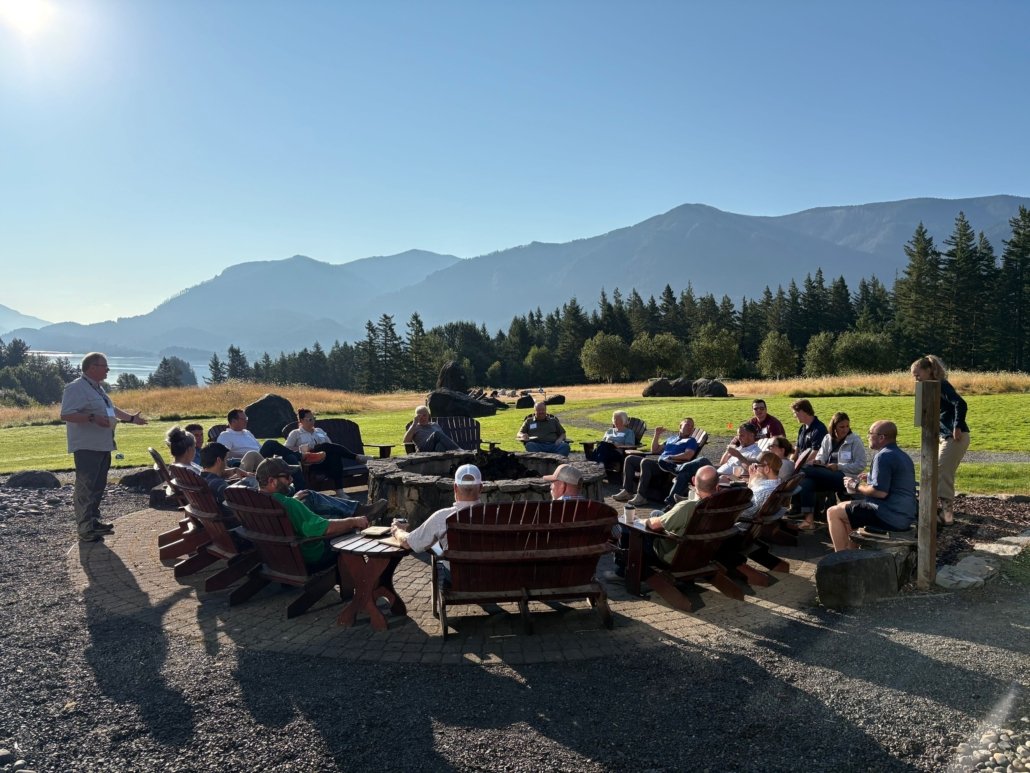
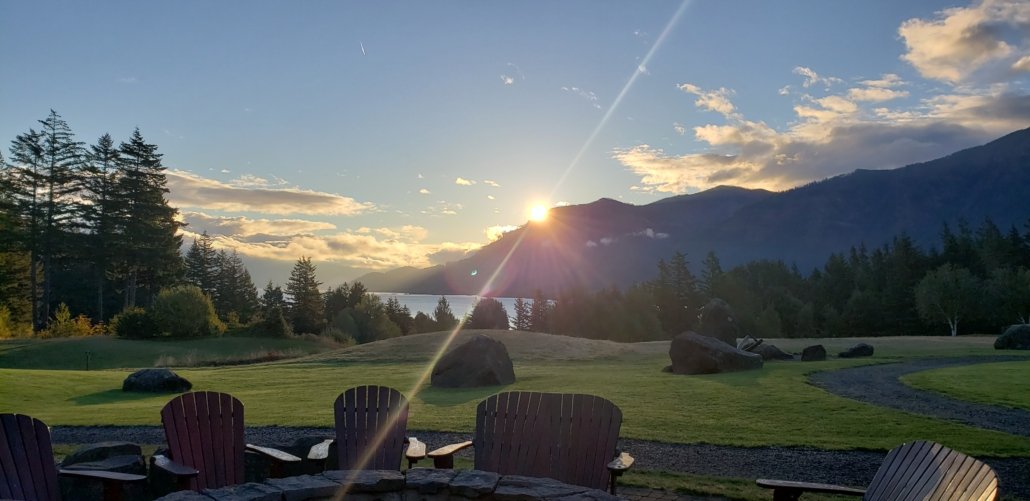
It happened at the cocktail reception before dinner. The sun was starting to drop behind the trees at Skamania Lodge, the white tablecloths on the garden patio lifting in the breeze, and the smell of dinner drifting across the lawn. One of the participants, beer in hand, approached. 

“So, I have a question for you. This morning, you asked about our “why”  — why we came to this program. What is your why? Why do you travel halfway across the country three or four times a year to guide this program?”

In five years, a dozen cohorts, and over two hundred participants, no one had ever asked me that.

I gave the first answer that came to mind: “I love the story, I love storytelling, I love seeing the lightbulb moments in people’s eyes when something connects.”

True enough. But the question stayed with me—over dinner, around the campfire that night, on the flight home. Why do I really do this? Especially now, when leaving Carmen is harder and harder with each trip.

Why – Deep Learning

I am honored to have been selected by my client, FCCS, to help build this program. What began as Carmen’s and my journey to follow the Lewis and Clark Trail blossomed into an entirely new career when Jean Canty Segal of FCCS read some of my writing about leadership and Lewis and Clark. She invited me to meet with a team of people in Seattle to discuss building the program. I was thrilled to be selected as a part of the team. 

It stretched me. I learned so much in those 18 months of developing the program. Not so much about Lewis and Clark, but about leadership development programs, experiential learning, and the discipline to bring their vision to life. I walked away from every meeting we had with new insights and new perspectives. 

From Sean Murray, I learned how to pace an experience so it flows.

From Matt Walker, I learned how the outdoors can carve a lesson deep into memory.

From Jared Nichols, I learned to stand in the future and imagine beyond the present.

My why? The learning never stops — and I love what we built.

Why – Continuous Learning

We launched the program in 2021, and since then, I’ve had the privilege of leading a dozen cohorts through the key concepts of Vision, Team Building, Overcoming Obstacles, Developing Resilience, and Proceeding On.

It never gets old. It never becomes routine. It never gets mailed in.

Each group arrives ready — hungry to learn, hungry to grow as leaders. They bond quickly and deeply. They are open to new and sometimes uncomfortable experiences. They push themselves. They challenge each other.

It’s a joy to watch it happen. Twenty strangers on the first night become friends, teammates, colleagues by the end of day one. They come from different industries, different parts of the country, different perspectives — yet they share a willingness to listen, to learn, and to support each other.

And I learn from every single one of them. Sometimes it’s an insight shared quietly after the hike or the aerial course. Sometimes it’s a reflection offered around the campfire, or a look across the table that says, Yeah, that makes sense now. Other times it’s a suggestion scribbled on a survey form (yes, we read every one), or a perspective I’d never considered, or a question no one had ever asked me before.

That constant exchange — giving and receiving, teaching and learning — is one of the things that keeps me coming back.

Why – Legacy

One of the leadership lessons we teach in the closing module is about legacy, not necessarily the legacy you leave behind when you leave this earth, but the legacy you leave behind in your team, in your teammates, when you transition to a new role or a new job. What do you hope they carry with them? 

I have grown so much through the program, sometimes taking to heart the very lessons I am teaching, perhaps in a different way. Like celebrating victories. As the facilitator, I too, need to celebrate victories, like the successful conclusion of another cohort. 

I have been thinking a lot about legacy as I approach the end of my career, as I move into the final chapter of life. What do I want to leave in the hearts and minds of others?

Family, of course. My wife Carmen — my partner in all things. Good times — tough times, through it all, I want her to carry my love in her heart. My sons, Jeremy and Brad. I see pieces of me in them — different pieces, similar pieces. Yet, they are their own men, teaching me each and every day. My grandkids  — Braxton, Jordan, Jasper, and Hayden, step grandkids Ari, Avery, and Henry, and step grandkids from a son’s prior marriage, Donny and Charity. Legacy.

The Indiana CIO Network. A group of IT professionals across Central Indiana and beyond. What started as five colleagues having lunch has grown into a group with over 400 members. Each member brings their insights and expertise  —  and their willingness to share and support each other. A new group of leaders have taken the reins and the group is thriving! Legacy. 

The Lewis and Clark Experience: A New Way Forward. There will come a time when I no longer serve as a guide for the program. Having the program on a solid foundation is one of the reasons I have poured my heart and soul into it. It is why we fine-tune it almost every time. That’s why I rehearse until I can forget the script and speak straight from the heart. Legacy.

The Journey

When Carmen and I first set out to follow the Lewis and Clark Trail, we had no idea what we’d discover. It became the theme of our life, the shape of my career, and the heart of my next book — Uncharted Moments Along the Lewis and Clark Trail – A Love Story.

I suppose that’s my real why: to keep the story alive — for the people in the room, for the people I love, and for the people I’ll never meet.

— Jeff

P.S. Over the next few months, I will be sharing more from my upcoming book, Uncharted Moments Along the Lewis and Clark Trail – A Love Story. If you want to be in the know as it proceeds through the publishing process, sign up for my newsletter in the side panel of this page!


If you’re a regular reader of Rivers of Thought, you’ve probably noticed I’ve been unusually quiet over the past year. No new reflections, no trail updates, no musings on leadership or love or life. Just… silence.

Not because I ran out of things to say.

But because life, as it often does, had other plans.

The past year has been a season of deep change—personally, spiritually, and emotionally. I won’t go into all of it here (not yet, anyway), but I will say this: there have been moments that brought me to my knees, and moments that reminded me—gently, fiercely—why I write in the first place.

So here I am, surfacing from the quiet to share something that’s been two decades in the making.

I’ve finished the manuscript for my next book.

It’s called:

Uncharted Moments – Along the Lewis & Clark Trail – A Love Story

It’s not a history book, though history plays a starring role.
It’s not a love story, though love is its heartbeat.
It’s not a memoir, though my fingerprints are on every page.

It’s a journey—along rivers, through loss, into wonder.

Twenty years ago, I found myself drawn to the story of Lewis and Clark. What began as historical curiosity quickly became something more personal. Carmen and I started tracing the trail together—not just on maps, but in life. We followed in the footsteps of the Corps of Discovery, yes—but we also discovered each other, one sacred, uncharted moment at a time.

This book tells that story.
Of the rivers we crossed. The history we absorbed.
The laughs. The tears. The whispered conversations in campgrounds and museum halls.
The epiphanies that hit you like a thunderclap… and the ones that sneak in like mist over water.

Uncharted Moments is about finding your path—not by following someone else’s map, but by walking it together.

In the weeks to come, I’ll be sharing more: a glimpse at the cover, some behind-the-scenes stories, a few treasures that didn’t make it into the manuscript, and ways you can be part of this next adventure.

For now, thank you for being here—for sticking around through the silence.
I can’t wait to bring you along on this new leg of the journey.

Still paddling,
Jeff


Here is a little teaser:

Excerpt from Uncharted Moments: Along the Lewis & Clark Trail — A Love Story

We arrived in Philadelphia with one goal in mind: to see the journals.

Not just any journals—the journals. The ones penned by Meriwether Lewis and William Clark themselves. The ones that had guided us, inspired us, haunted us over thousands of miles and twenty years of travel. I had traced their words across maps, through dusty archives and riverside trails, always chasing the next uncharted moment.

The American Philosophical Society Museum was closed. Not for the day. For three weeks.

A sign on the heavy door made it plain. Closed for renovation or installation—something vague but definitive. The kind of sign that doesn’t budge, no matter how far you’ve come or how much your heart is invested.

But Carmen wasn’t one to give up easily. She pressed the doorbell.

A moment later, a woman emerged—clearly on her way to lunch, keys in hand, purse on her shoulder. Her pace slowed when she saw us, but her body language said, “I’m already gone.” Still, she paused.

We told her our story. About how this journey began with a book of journal excerpts and a spark of curiosity that became a shared obsession. About the RV, the trails, the graves, the monuments, the river crossings, the heartbreak, the healing. All of it. Condensed into a few breathless sentences.

She asked, “Are you researchers? Academics?”

“No,” I said. “Just… believers.”

She tilted her head, considering. Then she gave us directions to the library—across the street—Carmen convinced her to take us.

After being asked again if we were academics, we were introduced to Nan.

Nan greeted us warmly, no sign of skepticism or hurry in her demeanor. She gave us a tour of the public spaces, weaving in bits of the Society’s history, its legacy of Enlightenment ideals, and early American curiosity. I tried to absorb it, but my eyes kept drifting toward the closed doors, the private corridors.

Eventually, Nan turned to us and said, “I hear you’re interested in Lewis and Clark, right?”

We both nodded.

Without another word, she led us through a quiet hallway, past a door with a keycard lock, and into a climate-controlled back room.

There was a table. A few chairs. Silence.

Nan directed us to sit down at the table and disappeared into the vault.

Carmen and I sat down, our hands resting flat on the wood. We didn’t speak. We looked at each other with ‘what’s going on’ faces.

And then—