Rivers of Thought
On Love, Legacy & the Discoveries Along the Way
Looking back, I can finally see the shape of the river.
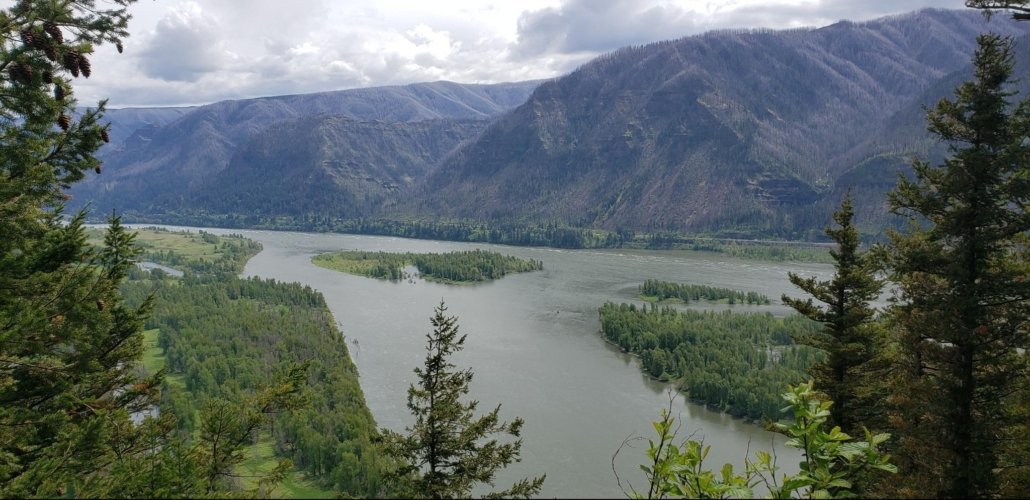
The Columbia River — a reminder that every journey carries bends, convergences, and quiet shifts we only recognize from a higher vantage point.
I’ve been thinking a lot lately about how a person changes. Not in the dramatic, overnight sense, but in the slow, river-shaped way—quiet bends, steady currents, the kind of transformation you only notice when you look back and realize the landscape is different.
When I first launched this blog in 2008, I thought I knew what it would be. I wrote about sustainability, energy usage, water conservation, and the triple bottom line. I was earnest, a little intense, and deeply convinced that if we understood our impact on the world, maybe we’d take better care of it. Those posts were full of metrics, light bulbs, gallons saved, and carbon footprints. But even then, beneath the wattage and water usage, there were hints of something more: rivers, memories, my grandmother’s wisdom, and the first murmurings of Lewis & Clark.
I thought I was writing about ecology.
Really, I was writing about responsibility—about what we leave behind.
From CIO to Leadership to Storytelling
As the years went on, my writing followed the arc of my professional life.
I became a CIO, a tech leader, a mentor. I started speaking more, teaching more, writing about careers and culture and teams. Rivers of Thought evolved into a place for leadership insights and IT strategy. Those posts carried frameworks, lessons learned, and the familiar rhythm of someone who had lived through enough change to have something useful to say.
But even then—even in the middle of talking about cloud migration or executive presence—something else kept knocking at the door.
A long drive with the radio up too loud.
A river hike that left me breathless.
A memory of my boys.
A story about Carmen’s quiet strength.
A moment where leadership had less to do with business and more to do with being human.
Little by little, the edges between “work” and “life” blurred. The posts became more reflective, more personal, more rooted in places and people rather than roles and responsibilities.
The Turning Point I Didn’t See Coming
If I had to pinpoint the moment my writing turned, it might be Thanksgiving Day, sometime in the early 90s. The boys were with their mom. I was moping around the house when the phone rang.
“Dad, are you listening?”
“Listening to what?”
“Arlo!”
Before I could reach for anything, Carmen quietly went to the shelf, pulled out her own copy of Alice’s Restaurant, and put it on. No fanfare. No commentary. Just a small act of presence that aligned our lives in a way I didn’t yet understand.
Years later, when I wrote How Arlo Guthrie Saved My Life, I thought it was a one-off story about a song and a holiday. Now I can see that it was more than that. It was the beginning of writing from the inside out.
Not CIO.
Not even “leader.”
Just Jeff.
A man listening to the love, loss, wonder, and serendipity that shape a life.
The Era of Sacred Ground
The last few years have carried their share of joy and grief—losing my father, becoming a caregiver, watching life shift in ways I never imagined, standing in places that felt unexpectedly holy. I found myself writing about:
-
cemeteries and hallowed places
-
family stories passed down through generations
-
the Land of Serendip
-
rivers I’ve walked beside for decades
-
the Lewis & Clark Trail and the long arc of history
-
the quiet, steadfast love of my wife, Carmen
I didn’t set out to write like this.
It happened the way rivers happen—cutting deeper channels over time.
Somewhere along the way, my writing became less about managing change and more about making meaning. Less about leading others and more about listening—for what the land, the past, and the heart have been trying to say all along.
The Next Chapter: Storyteller, Keeper of Legacy
Now, as I move fully into this next chapter of life, I’m no longer trying to separate the strands.
I’m not just a former CIO.
I’m not just a leadership guy.
I’m not even “just” a writer.
I’ve become a storyteller—
of rivers and trails,
of love and serendipity,
of family and legacy,
of what it means to stand on sacred ground.
This blog has always evolved as I’ve evolved.
And I’m grateful you’ve walked with me through every shift—
from ecology to leadership to legacy to these uncharted moments I now write about.
If you’ve been here since the beginning, thank you.
If we’ve lost touch somewhere along the way, I hope this helps you see where I’ve been and where the writing is taking me now.
And if you’re new here, welcome to the river.
I don’t know exactly where the next bend leads.
But I do know I’ll keep telling the truth as I find it—
one story, one moment, one sacred place at a time.
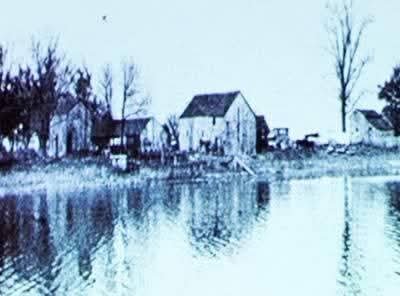
Ton Family Farm circa 1850
Last week, I stepped into a small Rotary meeting room to give a talk about something that has been quietly reshaping my sense of identity for years: my great-great-grandparents’ role in the Underground Railroad. It’s a story I’ve researched, written about, and carried with me — but this was the first time I’d ever stood in front of a group to tell it out loud, beginning to end.
I walked in with a laptop, a handful of slides, and more nerves than I expected.
I walked out with something else entirely.
Why This Talk Felt Different
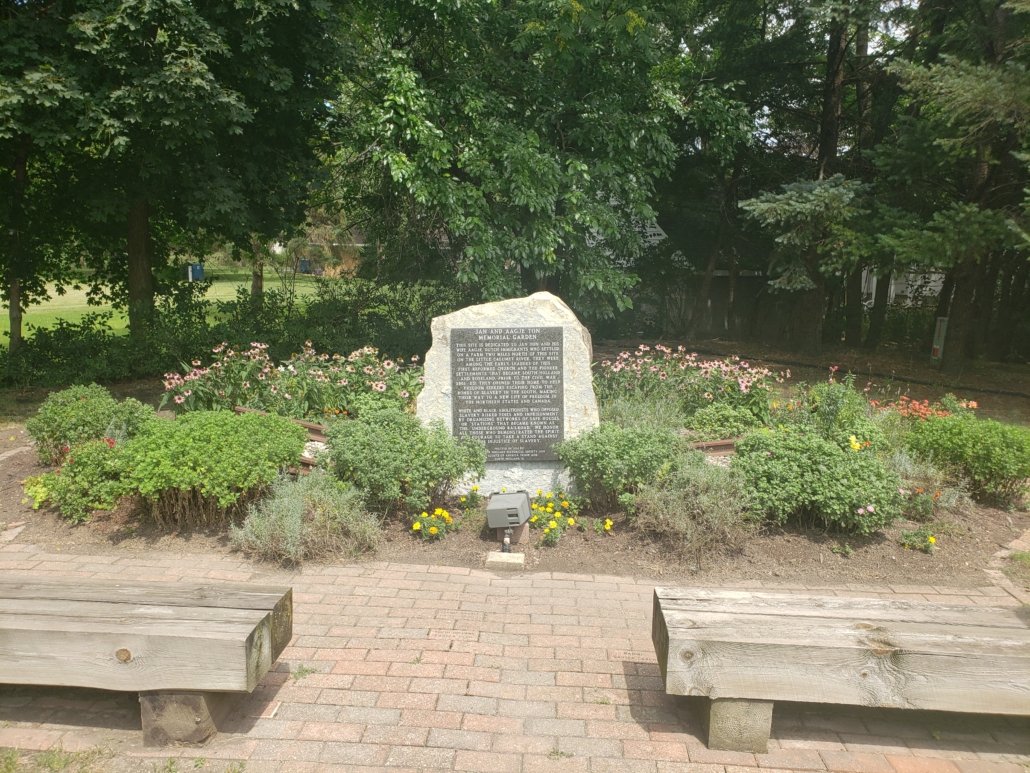
Most of the time when I write about my ancestors, I’m alone — at my keyboard, on a trail, or standing near the Little Calumet River where Jan and Aagje Ton lived and worked and quietly helped people seeking freedom. Writing gives you the gift of revision. Space. Distance.
But speaking?
Speaking asks for your whole self.
Speaking means feeling the story in real time — where your voice catches, where the room leans in, where silence does the work words can’t.
As I prepared the talk, I realized I wasn’t simply recounting history. I was carrying something forward. I was giving breath to people who acted with courage in the shadows, never imagining their names would be spoken in a Rotary meeting room in rural Indiana more than 170 years later.
A Small Room, A Big Moment
There were twelve people.
That’s it.
Twelve chairs arranged around a few tables.
And somehow, the room felt full.
People listened — really listened. They asked thoughtful questions. They stayed after to share memories of their own family histories, to reflect on courage, to connect threads I didn’t expect.
“I grew up in that area — never heard those stories. Amazing.”
“South Holland, huh? I remember going to the department store in South Holland.”
“There is a house right here in Attica that was involved in the Underground Railroad.”
Small phrases. Stories.
Big impact.
There was no political edge, no tension — even though conversations about the 1850s can easily drift that direction. The room remained grounded in humanity, with its moral decisions, the risks ordinary people faced, and the echoes we still feel today.
In an era when much conversation occurs online, in all caps, with little listening, it was refreshing — even restorative — to be reminded that face-to-face, people are still capable of curiosity, humility, and grace.
The Lesson I Didn’t Expect
Preparing this talk took hours — more than I planned, more than I had, if I’m being honest. And yet, standing in that small room, I felt something shift.
It wasn’t about the PowerPoint.
It wasn’t about the delivery.
It wasn’t even about the applause.
It was the realization that these stories matter because they ground us. They remind us where we come from. They remind us of the ordinary people who made extraordinary choices. And they remind us that history is never as far away as we think it is.
I thought I was giving a talk.
Turns out, I was receiving one.
One Last Connection
A few days before the presentation, I read Sheila Kennedy’s post “Courage and Concession,” a reflection on political conflict in the 1850s surrounding the issue of slavery. The courage of my ancestors — and the courage of the freedom seekers themselves — settled in my gut. Her words stayed with me as I spoke, not because the Rotary talk was political, but because courage looks remarkably similar across centuries.
Sometimes it’s dramatic.
Sometimes it’s quiet.
Most of the time, it’s ordinary people doing the right thing when it counts.
My ancestors didn’t ask to be heroes. They just opened the door.
There’s something in that for all of us.
I ended my talk with these words:
“And I think that’s what we’re all called to do in our own way — to open doors when we can, to tell the stories that remind us who we are.”
If You’d Like to Follow Along
If reflections like this resonate with you — stories of history, legacy, and the unexpected ways the past reaches into our lives — I’d love to have you join my newsletter. That’s where I share the behind-the-scenes pieces I don’t post anywhere else. Subscribe in the side panel of this page.
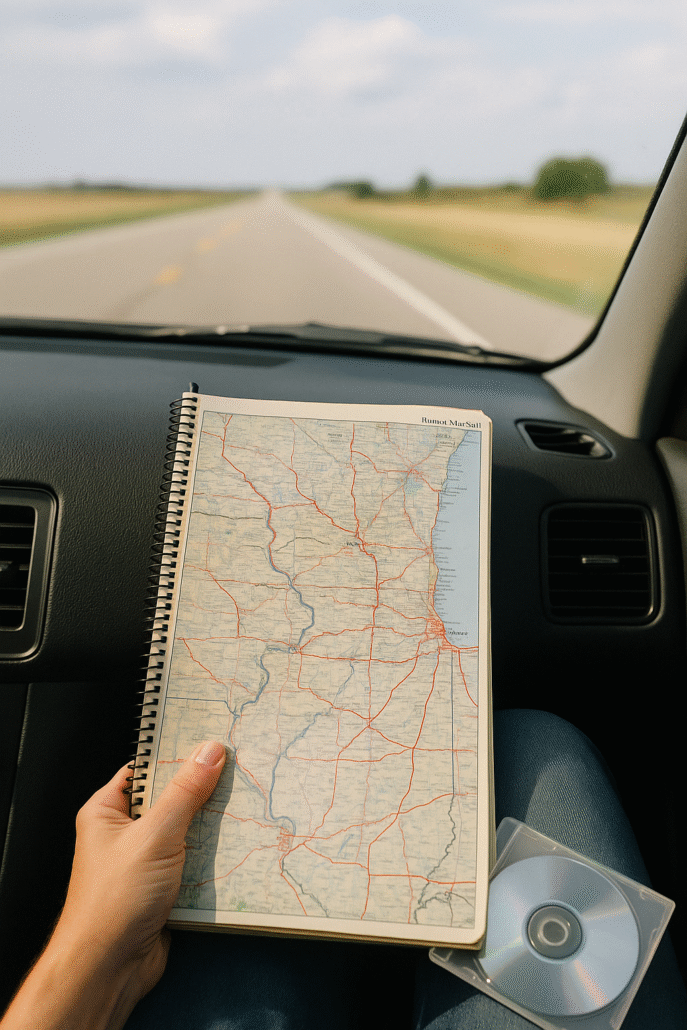
From paper to pixels, our favorite navigation system was still analog — Carmen and her atlas.
How the world changed beneath our wheels.
I was sorting through a box of old trip photos the other day — glossy 4×6 time capsules from a different century — when it hit me. Uncharted Moments isn’t just a story about where we went. It’s also about how the world changed beneath our wheels.
As Carmen and I followed the Lewis and Clark Trail, the technology around us evolved almost as quickly as the landscapes we drove through. What started as paper maps and mix CDs became satellite-guided routes, digital playlists, and cloud-backed memories.
It’s funny: while we were tracing the past, the future was quietly catching up to us.
Finding Our Way
In those early years, “navigation” meant one thing — MapQuest printouts. Six or seven pages of turn-by-turn directions so detailed they could’ve guided a lunar landing.
Carmen would sit in the passenger seat, papers spread across her lap, reading aloud like an auctioneer:
“Take ramp toward I-70 West. Go 0.1 miles. Merge onto I-70 West. Go 23.4 miles.”
Halfway through the second page, she’d look up and sigh.
“Didn’t we just do that?”
She wasn’t wrong. MapQuest had trust issues. It narrated everything. Getting off the ramp, getting back on, continuing straight. God help you if you missed a turn; by the time you found your place again, you’d already reached the next state.
Then came Microsoft Streets & Trips, which let us print maps with tidy flags and pastel highlights. I spent hours fine-tuning those routes — optimizing waypoints like I was planning a corporate network migration.
Eventually, we graduated to the Garmin GPS, that small oracle on the dashboard. “Recalculating…” became part of our soundtrack. When we upgraded to a BlackBerry with GPS, it felt like we were driving inside The Jetsons.
And yet, through all of it, Carmen never let go of her Rand McNally Atlas. The maps for each state were folded, worn, and lined with her notes — our analog breadcrumb trail.
Her skill with those maps bordered on the mystical. Once, using nothing but Granny’s journal and her atlas, she located the exact spot of my grandmother’s childhood farmhouse.
“If it’s four and a half miles northwest of here, and four northeast of there,” she said, tracing her finger over Pierce County, “then it must be right… here.”
Moments later, the farmhouse appeared on the left.
You don’t get that kind of magic from a GPS.
The Soundtrack of the Road
Our soundtrack evolved just like our maps.
In the beginning, it was FM radio — finding a station, losing it to static, scanning for something new. Carmen could sense a signal fading like a storm front.
We carried a massive CD binder, with Carmen as our DJ—the Stones, Clapton, Seger — the soundtrack of a thousand miles. On one trip, Sirius launched an all-Stones channel, and we made a game of it: we’d try to guess whether the next song would be by the Rolling Stones.
Of course, it always was. And every time, we’d laugh like kids.
Satellite radio felt like a revelation — hundreds of channels, coast to coast, no static. Later came streaming: Pandora, then Spotify, each algorithm learning our moods, our memories, our mile markers.
Still, I miss the surprise of radio. That serendipity when the perfect song just finds you on the open road.
Capturing the Moment
If navigation told us where we were going, and music carried how we felt, then photos preserved what we saw.
Our first trips were shot on 35mm film — 24 exposures per roll, every click a small gamble. We’d drop them at Walgreens and wait days, sometimes weeks, to find out if we’d actually captured the hawk, the river, the laugh.
Then came the digital camera, with its tiny 2×2 screen that gave you just enough feedback to think, maybe.
Later, our hard drives became overloaded with folders named “Trip3_FINAL” and “Trip3_REALLYFINAL.” We took more photos than we could ever sort — tens of thousands of them. Carmen was the master captioner, turning each image into a story: equal parts wit and wonder.
Now, our phones do it all — cameras sharper than anything we dreamed of thirty years ago, every image backed up to the cloud within seconds. Convenient, yes. But sometimes I miss the feel of a print — the weight of memory in your hand.
Then and Now
Somewhere between MapQuest and Google Maps, FM and Spotify, 35mm and the cloud, our story unfolded — not because of the technology, but in spite of it.
We found our way together. We learned to listen. We captured the moments that mattered.
The tools changed. The wonder didn’t.
And after all those years as a CIO chasing the next upgrade, I’ve realized something simple:
Sometimes the best innovation is still just looking out the window — together — and saying, “Proceed on.”