Continue with me as our Journey Through the Land of Serendip comes to an end. You may recall from the first two installments, this past summer two separate storylines from this blog collided in a wonderful adventure. We wrap up that adventure with one last stop on our journey through the Land of Serendip in Lake Geneva, Wisconsin.
Our journey began with a visit to Roseland and South Holland on the south side of Chicago. We then spent two days reminiscing and reuniting dad’s ashes with mom’s at Green Lake, Wisconsin. On that Monday, it was time to head home, but not by our familiar route. We had been invited to stop at the home of Duane and June DeYoung. Duane is my 3rd cousin, descended from Jan and Aagje Ton through their daughter, Pieternella, sister of my great grandfather, their son George. You may recall from the first leg of our journey, Duane had reached out to me after reading one of my posts here on Rivers of Thought.
Always game for an adventure, Carmen, Brad, and I decided to take the backroads from Green Lake to Lake Geneva and stay off the interstates. Wisconsin is a beautiful state and we enjoyed the rolling hills, the small towns, and the fields and pastures as we traveled the web of state roads, county roads, and well, even a gravel road or two. Our trip to Lake Geneva was without incident, well…except for that car I didn’t see coming on one of the little country roads, almost pulling out in front of it. No harm, no foul…just an increased heart rate for the three of us!
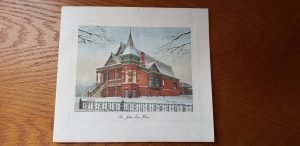
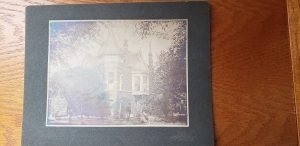 Duane had inherited a wonderful collection of photographs and keepsakes from his parents. His collection included many items of Ton family history. His prized possession was a painting he had commissioned based on a photograph of Jan and Aagje’s house in Roseland. Jan and Aagje spent most of their years on a farm on the banks of the Little Calumet River. When Jan retired from farming, he had a home built for their family “closer to town” in 1893. Their home stood at 416 W. 103rd Street until 1960 when it was torn down to make room for a parking lot.
His collection included photographs of Jan and Aagje, as well as, Lijntje (Steenbergen) Van Der Sijde, Aagje’s mother. There was also a Christmas Card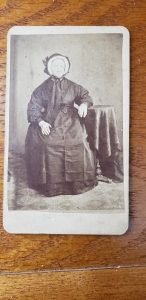 sent by the Pullman Bank & Trust that featured Jan and Aagje’s house. It was this image that Duane used for the painting.
 We spent hours pouring over his collection. Especially the album that contained the history of the Ton Family Reunions. There was a copy of almost every program dating back to the first reunion in 1896, the year Jan died. After his death, his son Cornelius organized a reunion to honor his father. The family (and the reunion) continued to grow. By 1911 the family decided to incorporate and elect officers. In 1945, the 50th-anniversary reunion, the family boasted 1,500 members. Life Magazine sent reporters and photographers and dedicated several pages in the September issue to the reunion. The Reunions would last another 10 years. In 1954, the members voted to make the 1955 reunion their last.
The programs included a wealth of information, including, births, deaths, marriages, and military service. There were even lyrics to the Ton Family song printed in most years. The reunions included speeches, games and activities, and a lot of storytelling!
A Journey Through the Land of Serendip has been all about collisions of storylines…the discovery of Jan and Aagje’s service on the underground railroad, colliding with the series of fairy tales I had written surrounding my father’s death, and lastly, the collision with the publication of the second edition of mom’s book. Lastly…or so I thought. There was another collision of storylines about to happen.
But first…we had a great visit with Duane and June. After sifting through his collection and dining on a lovely lunch prepared by June, we were on our way back to Indiana and home. Growing tired, we opted for interstate travel in lieu of the backroads!
This fall, in a desire to learn more about the Ton family history, I was doing some research between appointments. I stumbled across a letter. A letter that would be yet another collision of storylines.
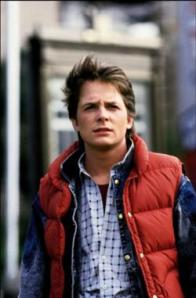
In 2014, I wrote a series of blogs titled the Roosevelt River. They were reflections and insights uncovered in 2013 during sessions with my executive coach, Dr. Dan Miller. Dan’s coaching is based on history. He uses the metaphor of a river to talk about life’s journeys. 2013 was my first year working with Dan. That year we explored the life of Theodore Roosevelt. Roosevelt has been an integral part of my leadership development ever since. (If you haven’t read Roosevelt River, I encourage you to do so. There are some incredible leadership lessons there, including from my dad, my brother, Marty McFly, and Frank Reagan.)
That is why I almost fell out of my chair when I Googled Cornelius J. Ton and found this entry:

Hardly able to contain myself, I clicked the link and found this:
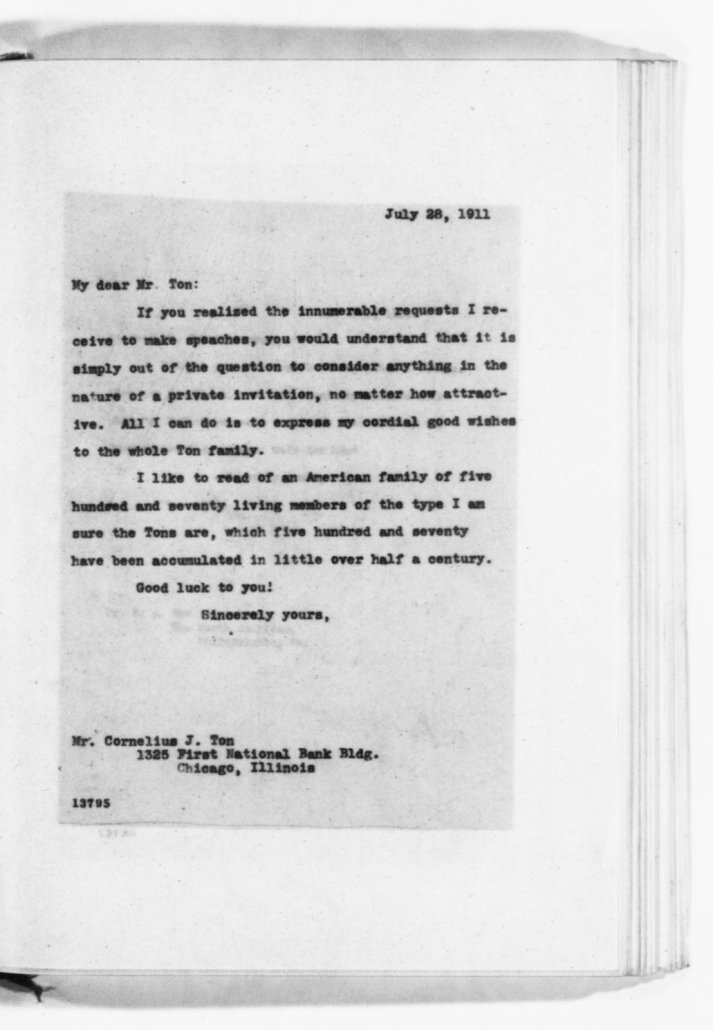
A letter from Theodore Roosevelt to my second great uncle! Oh, how I wish I could see the actual letter. Oh, how I wish I could see the letter Cornelius wrote to Roosevelt! The letter does not state the private event Cornelius was asking Roosevelt to attend. Given the reference to the Ton Family, I can only conjecture that he was inviting him to speak at the reunion in 1911 or 1912.
There you go. Another serendipitous collision. This series has been about collisions of storylines, written and unwritten. It began when the series “A Journey” collided with the fairy tale series, “The Land of Serendip”. That story then collided with the story of bringing my mom’s book back to life. Those stories then collided here with a series I wrote in 2014. Collisions, connections, coincidences, no matter what we call them, life is a web of stories…our stories. I don’t know where this journey will take us next, I don’t know where this journey will end. What I do know is that I look forward to the insights and lessons that lay around the next bend in the river!
Related Posts:
Part II: A Journey Through the Land of Serendip
A Journey Through the Land of Serendip [Part I]
The Land of Serendip Revisited
The Land of Serendip – The Final Chapter


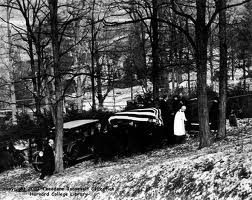 It was a cold, gray January day. The wind picked up the dusting of snow from the ground and flung it into their faces, stinging like needles. Tears froze to wind burned cheeks. The casket was slowly lowered into the frozen ground. A lone bugler played taps. Slowly, one by one, the people who had gathered, made their way down the 26 steps, down the long hill, and out of the cemetery until a lone figure remained. He stood motionless. His gaze locked on the hole before him. Tears stained his ruddy cheeks. His long coat flapped in the wind. His lips moved as if talking. Was he saying goodbye? Was he saying a prayer? Was he saying words of forgiveness to his now dead friend?


 A couple years ago I wrote a short eBook titled “
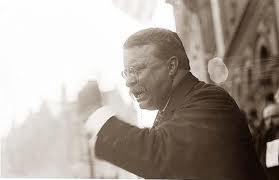 roosevelt speaking and you will find hundreds of pictures but you would be very hard pressed to find any of him standing still behind a lectern. You will see him teeth bared, leaning forward, fist pounding in hand, or arms spread wide. Some of these were very much thought out, others were as natural to him as speaking itself. The audience was captivated, he was talking with them (not TO them), he was their voice. Roosevelt once declared “I’m am not public opinion, I am the public”, a bold statement certainly, but at the height of his presidency he was absolutely correct.
 room, “THAT is the first time I have EVER understood technology!” Suddenly that petrified sixth grader wanted to jump for joy, wanted to slap high five with someone, anyone. Even now as I write this, I get chills. How did it happen? How did we get our point across? An image…permit me to go back in time a bit.
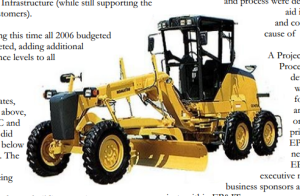 This was a company that made multi-million dollar decisions every day. How did they get comfortable with the risk versus the reward? They used a very tried and true process. The development group would envision a project, do their research and then
 build what was called internally “an Investment Memo”. The Investment Memo had 20 or 21 distinct sections, The Executive Summary, the elevation drawings, market surveys, risks, financial proforma and others. What if we put the strategic plan in the form of an Investment Memo? We could use the analogy that building IT systems are like building a building. But…no one on my team, myself included, had ever written an Investment Memo, we didn’t even know all the sections or the lingo. I reached out to a coworker who worked in the construction department. He had an interest in IT, was young and passionate. Would he help me?
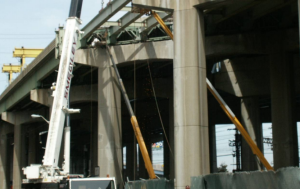 w to his hometown of Charlotte. He and I literally locked ourselves in my hotel room for three days. The result? An image! The image of a building, complete with elevation drawings and a proforma. An image that everyone in the room would understand. (Thanks to Matt Cashatt, for working his day job and burning the midnight oil with me for three days…and thanks to his wife for letting me impinge on their family time!)

 What makes great leaders great? Is there a moment, an event, that you can point to and say “this is when they became great”, or “this is when they made history”, or even “this is when they became presidential”? Is there a catalyst, an event, where they stand up and lead? Meriwether Lewis was Thomas Jefferson’s secretary, William Clark was hanging out in a cabin in the southern Indiana territory (sorry, I HAVE to throw my heroes in the mix, I know they weren’t presidents), Lincoln was a no-named lawyer from Illinois, Benjamin Harrison played ostrich and stuck his head in the sand for the first two years of the civil war, Roosevelt was considered for the head of street cleaning in New York, and Eisenhower was a mid-level officer primarily known for being a good football coach. What happened? How did they end up in history books? Why are we (read “me”) still talking about them 50, 100, and 200 years later?