
The room fell silent as I walked in. I got the feeling I had interrupted a joke or a story. It was my first time at the table. The proverbial table. The table at which we all talk about being seated. The table of power. Here were gathered, the ten most powerful people in our company, sans the owner himself. It was intimidating, to say the least. I was nervous. Nervous? Hell, I was scared shitless. I had 20 minutes to lay out the IT Strategic Plan. 20 minutes to convince them to invest a boatload of cash. THEIR cash. 20 minutes to convince the strategy was the RIGHT strategy. Clutching my notes in one hand and the “clicker” in the other, I went through the slides. There were a few clarifying questions, but mostly there was silence. As I closed with my summary and stopped, all eyes were focused, not on my slides, but on me. Was this going to be the nightmare from my childhood all over again? That terrified sixth grader wanted to scream and run. Breathe. Breathe deep. Then…then it happened…
The President of our company, leaned back in his chair, clasped his hands behind his head and said, more to me, than the  room, “THAT is the first time I have EVER understood technology!” Suddenly that petrified sixth grader wanted to jump for joy, wanted to slap high five with someone, anyone. Even now as I write this, I get chills. How did it happen? How did we get our point across? An image…permit me to go back in time a bit.
One of my first duties as the new CIO (my first CIO role, by the way), was to develop a three year technology strategic plan. Work on this had started before I even joined the company with me working behind the scenes to select the 3rd Party consulting firm as a partner in developing the plan. Once I officially started, work began in earnest. Weeks went by. The consultant did a yeoman’s job of gathering data, meeting with me and other stakeholders, working with the team to flush out the details. Weeks turned into months. We had a lot of great stuff, but nothing was coming together. The document being produced had a lot of words…much more than 1,000 trust me. It just wasn’t conveying the message. We needed something…but what? Something to pull it all together. An idea began to form. We needed a way to convey some very complex messages to an audience that was, by their own admission, not technical. (I knew I was in trouble when one SVP looked at me during a discussion and said “Technology? We don’t need technology, we used to design buildings with pencils and drawing paper, we can do it again.”)
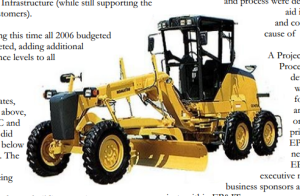 This was a company that made multi-million dollar decisions every day. How did they get comfortable with the risk versus the reward? They used a very tried and true process. The development group would envision a project, do their research and then
 build what was called internally “an Investment Memo”. The Investment Memo had 20 or 21 distinct sections, The Executive Summary, the elevation drawings, market surveys, risks, financial proforma and others. What if we put the strategic plan in the form of an Investment Memo? We could use the analogy that building IT systems are like building a building. But…no one on my team, myself included, had ever written an Investment Memo, we didn’t even know all the sections or the lingo. I reached out to a coworker who worked in the construction department. He had an interest in IT, was young and passionate. Would he help me?
I fle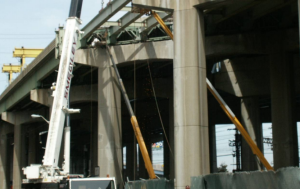 w to his hometown of Charlotte. He and I literally locked ourselves in my hotel room for three days. The result? An image! The image of a building, complete with elevation drawings and a proforma. An image that everyone in the room would understand. (Thanks to Matt Cashatt, for working his day job and burning the midnight oil with me for three days…and thanks to his wife for letting me impinge on their family time!)
It is true, an image IS worth a 1,000 words (or, in this case, several thousand words). A few years after the strategic plan presentation, as I explored the #RooseveltRiver, time and time again I discovered Theodore Roosevelt understood this, as well. Sometimes he created the images, sometimes others created them, but he always leveraged them. On a hunting trip, he and his group came upon a small bear chained to a tree. Even at the urging of some around him, he would not shoot the bear. Within days the image of the Teddy Bear was all over the press. During a speech he quoted an African proverb about “walk softly but carry a big stick”. The next day hundreds of people turned out at a speech carrying baseball bats and clubs. Later as he introduced the “Square Deal”, held up scales to convey he wanted all people to have fair deal and make a fair wage. These images were burned in the minds of his constituents.

Washington Post
Images can be a powerful tool. They can be intentional, as in the case of the scales, or unintentional like the Teddy Bear. What images are emblazoned on your mind? What images can you use to communicate to your team? to your peers? to your management? What intentional images can you create? What un-intentional ones can you leverage to get your point across?
#RooseveltRiver is my year long exploration with Dan Miller of Historical Solutions into leadership using the backdrop of history and the life of Theodore Roosevelt. To read more in this series, select “Roosevelt River” from the Category drop down on the right.
If anything you read here or in other posts strikes a chord, I would love to hear from you. Leave a comment, hit me up on Twitter (@jtongici), find me on LinkedIn, or Google +.
 What makes great leaders great? Is there a moment, an event, that you can point to and say “this is when they became great”, or “this is when they made history”, or even “this is when they became presidential”? Is there a catalyst, an event, where they stand up and lead? Meriwether Lewis was Thomas Jefferson’s secretary, William Clark was hanging out in a cabin in the southern Indiana territory (sorry, I HAVE to throw my heroes in the mix, I know they weren’t presidents), Lincoln was a no-named lawyer from Illinois, Benjamin Harrison played ostrich and stuck his head in the sand for the first two years of the civil war, Roosevelt was considered for the head of street cleaning in New York, and Eisenhower was a mid-level officer primarily known for being a good football coach. What happened? How did they end up in history books? Why are we (read “me”) still talking about them 50, 100, and 200 years later?


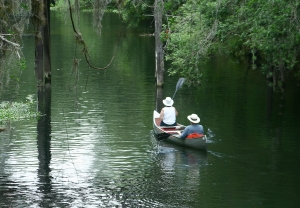

 Isn’t that the definition of being a leader, though? Living on the edge, continually pulling those around you out of the center? It is difficult, like being caught in a whirlpool above a rapids (hey this is a series about a RIVER), the closer to the center you are the harder and harder it pulls you in. The further and further away from the center, the swimming gets easier, but you can’t pull anyone with you. If you get too far on the edge you run the risk of being thrashed about in the rapids.
 people all the time. “Its not me,” was his reply, “its my persona. Just like when I was a dancer, I put on my persona and hide myself inside it”. BAM! Another lesson on the #RooseveltRiver hits me like a rock in the rapids. Sometimes the more obvious the lesson, the harder it smacks you. Its like the preparation my son does before he gets on stage, the preparation my dad did prior to a sermon, its like the preparation I do before a big presentation. We may not have described it as a persona…but its a perfect way of looking at it. THAT’s how you work a room…prepare and put on your persona.
 than I, I assumed it would have been either Lewis or Clark, at the very least, one of the men that accompanied them on their adventure. I knew very little about Roosevelt, but I was game. So I threw my canoe in the river and began my journey.
 At first there was some awkward chit-chat and bemusement, I don’t think many of them could believe we were actually on a hay ride. The further along the pathways we traveled, the polite chit-chat gave way to laughter, spirited conversation and picture taking. You could sit and watch the inner child come out. By the time, we were halfway done, there was debate about which wagon was the “cool, more fun wagon”. (Personally, I think the one I was in was the cool wagon!).
 Recently Seth Godin posted his
  snowfall, the Mud Creek valley was a winter wonderland. At first glance it is a world of black and white. However if you look closely it is a palette of dozens of shades of black: charcoal, ebony, midnight blue, onyx, noir, and jet; dozens of shades of white: snow, ivory, cornsilk, powder, cream, and antique; and yes, dozens (though I didn’t count to 50) shades of grey: light grey, silver, Davy’s grey, ash, slate and Xanadu. There are even shades of greens and browns.