
OK, before you movie buffs tell me “Marty McFly never met Theodore Roosevelt, much less paddle a river with anyone!” Keep your pants on for a minute, I can explain.
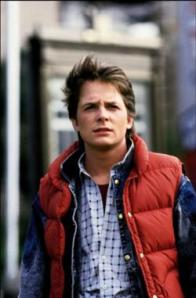 For those of you who have lived in a cave for the last 25 years, Marty McFly is the lead character in the movie trilogy “Back to the Future”. Marty is transported back in time in a Delorean from 1985 to 1955. (Holy crap, do you realize in Back to the Future II, Marty travels 30 years into the future to 2015, that, my friends, is less than six months away!) While in 1955, Marty changes the course of history and his life, by inadvertently preventing his mom and dad from having their first kiss, and interrupting their density (sic). He then spends the rest of the movie trying to fix history before (his) time runs out.
That moment, that kiss, was an “event angle”, a moment in time where you and you alone stand at a crossroads, faced with a decision, life will be dramatically different depending on the choice you make at that moment. Even without Marty’s intercession, George could have chickened out and never kissed Lorraine. Lorraine could have slapped him for an unwanted advance. We are all faced with these “event angles” in our lives, major decision points that present themselves to us. This might be a marriage, a divorce, birth of a child, death of spouse, a new job, or perhaps a termination from a job. The decisions we make at these times say a lot about who we are as people, and who we are as leaders.
Teddy Roosevelt was faced with such an “event angle” in 1912 (no it did not involve a kiss!). He had just lost the presidential election to Woodrow Wilson (by a large margin I might add). He was quoted as saying that defeat was either Bull Run or Waterloo, only time would tell. Interesting choice of words. Bull Run one of the earliest battles of the Civil War and Waterloo, the war that brought an end to Napoleon’s rein. Two diverging meanings. The beginning of a long struggle, or the end of power. I think the most telling part of Roosevelt’s quote, was “only time will tell”. He was giving up, he was leaving it up to fate. Gone was the bravado he was so famous for exhibiting, he was…defeated.
Like so many “event angles” in life, Roosevelt had put himself in this position by conscious decisions. He had left the presidency

Theodore Roosevelt and William Howard Taft, 1912 Credit: Topical Press Agency/Hulton Archive/Getty Images
in 1908. Taft, his chosen successor, had won the election. Roosevelt, now an international rock star went on an extended tour of Europe. Taft, however, was not Roosevelt. Roosevelt began to disagree publicly with Taft’s policies. As election time drew near, he began to contemplate another presidential run, eventually throwing his hat in the ring for the Republican Nomination and destroying his friendship with Taft in the process. Taft prevailed. Roosevelt could have seen the signs, instead he chose to run as a 3rd party candidate, in essence splitting the vote and giving the election to Wilson. Couldn’t he see this coming? Didn’t he see his popularity had waned during his European Tour? Was he so filled with hubris that he felt he could not be beat? And, what of his relationship with Taft. They had been very close. They would never speak again.
What can we learn from Roosevelt? What can learn from McFly? Many times in life, we will find ourselves at a crossroads, at an “event angle”. Rarely does life put us there at random. Usually we are there because of decisions and actions we made previously. While we cannot predict the future, we should consider the future consequences when plotting our courses. Had Marty not gone to meet Doc in 1985, he would not have been transported back to 1955 and changed the course of history. Had Roosevelt not decided to run for another term, he would not have destroyed his friendship, Wilson might not have won the election, and who knows the impact Roosevelt could have had in Europe as the world plummeted towards war.
We must also recognize “event angles” for what they are, major decisions that will change the course of our businesses and even our lives. We cannot do as Roosevelt did and “let time tell”. What if Roosevelt had seen this loss as an opportunity, dare I say, a victory? When we are faced with “event angles”, we can choose the way those decisions impact us. Even if the “event angle” is forced up us by life (divorce, death of a loved one, termination of a job), we can choose how we react to those events. We can take the path of Roosevelt and give up in the face of defeat, or we can choose to live on, lead on, and to make an impact.
Now, if you will excuse me, I’m going to grab some popcorn, my best gal and watch “Back to the Future”…again!
#RooseveltRiver is my year long exploration with Dan Miller of Historical Solutions into leadership using the backdrop of history and the life of Theodore Roosevelt. To read more in this series, select “Roosevelt River” from the Category drop down on the right.
If anything you read here or in other posts strikes a chord, I would love to hear from you. Leave a comment, hit me up on Twitter (@jtongici), find me on LinkedIn, or Google +.
 A couple years ago I wrote a short eBook titled “
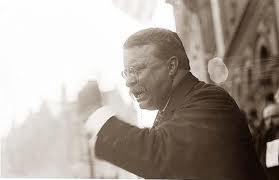 roosevelt speaking and you will find hundreds of pictures but you would be very hard pressed to find any of him standing still behind a lectern. You will see him teeth bared, leaning forward, fist pounding in hand, or arms spread wide. Some of these were very much thought out, others were as natural to him as speaking itself. The audience was captivated, he was talking with them (not TO them), he was their voice. Roosevelt once declared “I’m am not public opinion, I am the public”, a bold statement certainly, but at the height of his presidency he was absolutely correct.
 room, “THAT is the first time I have EVER understood technology!” Suddenly that petrified sixth grader wanted to jump for joy, wanted to slap high five with someone, anyone. Even now as I write this, I get chills. How did it happen? How did we get our point across? An image…permit me to go back in time a bit.
 This was a company that made multi-million dollar decisions every day. How did they get comfortable with the risk versus the reward? They used a very tried and true process. The development group would envision a project, do their research and then
 build what was called internally “an Investment Memo”. The Investment Memo had 20 or 21 distinct sections, The Executive Summary, the elevation drawings, market surveys, risks, financial proforma and others. What if we put the strategic plan in the form of an Investment Memo? We could use the analogy that building IT systems are like building a building. But…no one on my team, myself included, had ever written an Investment Memo, we didn’t even know all the sections or the lingo. I reached out to a coworker who worked in the construction department. He had an interest in IT, was young and passionate. Would he help me?
 w to his hometown of Charlotte. He and I literally locked ourselves in my hotel room for three days. The result? An image! The image of a building, complete with elevation drawings and a proforma. An image that everyone in the room would understand. (Thanks to Matt Cashatt, for working his day job and burning the midnight oil with me for three days…and thanks to his wife for letting me impinge on their family time!)

 What makes great leaders great? Is there a moment, an event, that you can point to and say “this is when they became great”, or “this is when they made history”, or even “this is when they became presidential”? Is there a catalyst, an event, where they stand up and lead? Meriwether Lewis was Thomas Jefferson’s secretary, William Clark was hanging out in a cabin in the southern Indiana territory (sorry, I HAVE to throw my heroes in the mix, I know they weren’t presidents), Lincoln was a no-named lawyer from Illinois, Benjamin Harrison played ostrich and stuck his head in the sand for the first two years of the civil war, Roosevelt was considered for the head of street cleaning in New York, and Eisenhower was a mid-level officer primarily known for being a good football coach. What happened? How did they end up in history books? Why are we (read “me”) still talking about them 50, 100, and 200 years later?


 I pledge Allegiance to the flag of the United States of America and to the Republic for which it stands, one nation under God, indivisible, with Liberty and Justice for all.

 Isn’t that the definition of being a leader, though? Living on the edge, continually pulling those around you out of the center? It is difficult, like being caught in a whirlpool above a rapids (hey this is a series about a RIVER), the closer to the center you are the harder and harder it pulls you in. The further and further away from the center, the swimming gets easier, but you can’t pull anyone with you. If you get too far on the edge you run the risk of being thrashed about in the rapids.
 people all the time. “Its not me,” was his reply, “its my persona. Just like when I was a dancer, I put on my persona and hide myself inside it”. BAM! Another lesson on the #RooseveltRiver hits me like a rock in the rapids. Sometimes the more obvious the lesson, the harder it smacks you. Its like the preparation my son does before he gets on stage, the preparation my dad did prior to a sermon, its like the preparation I do before a big presentation. We may not have described it as a persona…but its a perfect way of looking at it. THAT’s how you work a room…prepare and put on your persona.

