
 A couple years ago I wrote a short eBook titled “Everything I Learned about Leadership…I Learned from Lewis and Clark“. Well, guess what? It was a lie! As the dedication in the book declares, I really learned about leadership from my dad! Dad spent the majority of his career as an American Baptist minister, later taking roles in denomination leadership. What this meant was, that as a kid, I spent a LOT of time in church and a LOT of time listening to him preach. Think about it…18 years, give or take…Sunday morning service, Sunday night service, Wednesday service…and all the special services like Maundy Thursday, Good Friday, and Christmas Eve. A conservative estimate says it was over 2,000 sermons!
Today, almost 40 years since he was last my pastor and probably 10 to 15 years since I have heard him preach, I can remember many (ok not all 2,000, but many) of them. Why? or better yet, how? I can’t remember what I had for breakfast this morning, but I can remember the time he had one of the drollest members of the congregation walk up and eat an apple, leaving the core on the alter during “pledge” Sunday, or when some of the youth stood up and questioned him in the middle of a sermon (planned as a part of youth Sunday of course), or the many times, he would take on a persona of a character from the bible…Peter and Paul being the most memorable or the old lady who proclaimed “You ain’t e’er gonna shroud that light, eer ya?” as an adult lesson of the children’s song “This Little Light of Mine”, or , or even the time he stopped mid-sentence and asked my mother to go to his office and get the copy of his sermon because he’d lost his train of thought and his notes weren’t helping (he STILL says this was not planned).
Why do I remember them? I can hear you saying, “Oh sure, you remember those, they had memorable moments, something that set them apart”. Of course they did, I guess that’s the point. He was (is) a master at creating a visualization through a gesture or an action, some way of saying “This is important! Pay attention!” When he got out from behind the podium, I would (the whole congregation would) sit up and take notice. It was the energy and forcefulness (not in a hell-fire and brimstone sort of way, mind you), but in a way to capture all of our senses. It might have been as simple as pacing across the front of the church, or as in the examples above something even more captivating. As I reflect on this now, my guess is many of the gestures just became a natural part of his delivery when he wanted to make a point, still others were very rehearsed and planned.
Like my dad, Roosevelt was a master at making a point through a gesture. Do an image search on Google for theodore 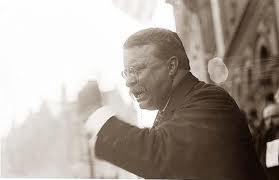 roosevelt speaking and you will find hundreds of pictures but you would be very hard pressed to find any of him standing still behind a lectern. You will see him teeth bared, leaning forward, fist pounding in hand, or arms spread wide. Some of these were very much thought out, others were as natural to him as speaking itself. The audience was captivated, he was talking with them (not TO them), he was their voice. Roosevelt once declared “I’m am not public opinion, I am the public”, a bold statement certainly, but at the height of his presidency he was absolutely correct.
For me, I inherited my dad’s propensity to wander away from the lectern to make a point, to engage with my listeners. Even during my monthly staff meetings I stand so I can move around. During my exploration of #RooseveltRiver, Dan challenged me to think about times or messages when I should break from the natural, instinctive gestures to make the point even more impactful. Recently, I had the distinct privilege to speak at a high school graduation (future post alert!) as I thought about my words and my delivery, I realized this was one of the times Dan was referring to. What I said was irrelevant. It was not about the message. It was about the graduates, their families and their celebration. I delivered my short remarks passionately, yet standing still behind the lectern. Think about your own delivery. How do you emphasize your points? When you are presenting to your team, the board or a larger audience is your point made by some instinctive gesture? Do you rehearse and plan your gestures? Sometimes the natural, instinctive gestures are the most powerful, however, there are other times that may call for a more intentional, rehearsed gesture, or even times when no gesture at all is the course of the day.
#RooseveltRiver is my year long exploration with Dan Miller of Historical Solutions into leadership using the backdrop of history and the life of Theodore Roosevelt. To read more in this series, select “Roosevelt River” from the Category drop down on the right.
If anything you read here or in other posts strikes a chord, I would love to hear from you. Leave a comment, hit me up on Twitter (@jtongici), find me on LinkedIn, or Google +.
 room, “THAT is the first time I have EVER understood technology!” Suddenly that petrified sixth grader wanted to jump for joy, wanted to slap high five with someone, anyone. Even now as I write this, I get chills. How did it happen? How did we get our point across? An image…permit me to go back in time a bit.
 This was a company that made multi-million dollar decisions every day. How did they get comfortable with the risk versus the reward? They used a very tried and true process. The development group would envision a project, do their research and then
 build what was called internally “an Investment Memo”. The Investment Memo had 20 or 21 distinct sections, The Executive Summary, the elevation drawings, market surveys, risks, financial proforma and others. What if we put the strategic plan in the form of an Investment Memo? We could use the analogy that building IT systems are like building a building. But…no one on my team, myself included, had ever written an Investment Memo, we didn’t even know all the sections or the lingo. I reached out to a coworker who worked in the construction department. He had an interest in IT, was young and passionate. Would he help me?
 w to his hometown of Charlotte. He and I literally locked ourselves in my hotel room for three days. The result? An image! The image of a building, complete with elevation drawings and a proforma. An image that everyone in the room would understand. (Thanks to Matt Cashatt, for working his day job and burning the midnight oil with me for three days…and thanks to his wife for letting me impinge on their family time!)

 What makes great leaders great? Is there a moment, an event, that you can point to and say “this is when they became great”, or “this is when they made history”, or even “this is when they became presidential”? Is there a catalyst, an event, where they stand up and lead? Meriwether Lewis was Thomas Jefferson’s secretary, William Clark was hanging out in a cabin in the southern Indiana territory (sorry, I HAVE to throw my heroes in the mix, I know they weren’t presidents), Lincoln was a no-named lawyer from Illinois, Benjamin Harrison played ostrich and stuck his head in the sand for the first two years of the civil war, Roosevelt was considered for the head of street cleaning in New York, and Eisenhower was a mid-level officer primarily known for being a good football coach. What happened? How did they end up in history books? Why are we (read “me”) still talking about them 50, 100, and 200 years later?


 I pledge Allegiance to the flag of the United States of America and to the Republic for which it stands, one nation under God, indivisible, with Liberty and Justice for all.

 Isn’t that the definition of being a leader, though? Living on the edge, continually pulling those around you out of the center? It is difficult, like being caught in a whirlpool above a rapids (hey this is a series about a RIVER), the closer to the center you are the harder and harder it pulls you in. The further and further away from the center, the swimming gets easier, but you can’t pull anyone with you. If you get too far on the edge you run the risk of being thrashed about in the rapids.
 people all the time. “Its not me,” was his reply, “its my persona. Just like when I was a dancer, I put on my persona and hide myself inside it”. BAM! Another lesson on the #RooseveltRiver hits me like a rock in the rapids. Sometimes the more obvious the lesson, the harder it smacks you. Its like the preparation my son does before he gets on stage, the preparation my dad did prior to a sermon, its like the preparation I do before a big presentation. We may not have described it as a persona…but its a perfect way of looking at it. THAT’s how you work a room…prepare and put on your persona.


 than I, I assumed it would have been either Lewis or Clark, at the very least, one of the men that accompanied them on their adventure. I knew very little about Roosevelt, but I was game. So I threw my canoe in the river and began my journey.
 Road 46 between Indianapolis and Nashville (Nashville, Indiana that is). My first wife, our two kids and I were heading to her mom’s place for Thanksgiving. The drive was going, well, it was going like you would expect it to go with two boys under the age of 10 strapped in a car in the days before iPods, Gameboys, iPads, and cars with DVD players. Even though it wasn’t a long drive, they were still bouncing off the ceiling. My wife was reading, and me? I was jamming out to Q95 (well, as jamming out as you can be with a wife and two kids in the car).
 back, listening to the same Q95, low and behold they played the same song, at the exact same time! Amazing! What is the coincidence of that? (Ok, it wasn’t for another year or two that I realized it was a Q95 Thanksgiving day tradition to play Alice’s Restaurant at Noon, I was a REAL slow learner back then!)
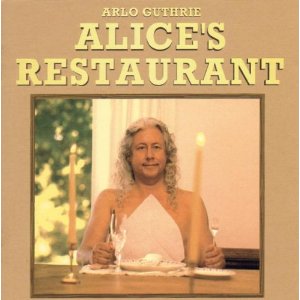 and Brad, their families, our folks, and the occasional friend, we play “Alice’s Restaurant” and sing along. We even printed off all the lyrics so our folks could be sure and follow along. Dave and his wonderful baritone providing cover for all the rest of us who can’t really sing.