From “Down an Indian Trail in 1849” by Mary K. Rowlands
Last month, as you may recall, I invited you along on a journey: a journey of discovery into some of my family history. I’ve learned a lot in one month..but have a lot more to learn. I’ve exchanged LinkedIn messages with LeRone Branch, the Eagle Scout turned Tax Accountant, who helped develop the memorial to my great-great-grandparents Jan and Aagje (Vander Sijde) Ton. I’ve emailed several times with Paul Ton of Michigan, descended from Jan’s brother, Harmen, and I’ve read two and a half books that mention Jan and others in the Ton family.
Correcting the Record
Part of what I have learned is that I had some of my facts wrong in my post last month. In that post, I mentioned Jan and Aagje immigrated to the U.S from Holland (Netherlands) in the 1840s with eight of their nine children. That is not correct. As is often the case with old records, it is easy to get confused when children carry the same name as one of their parents. Many times records do not include suffixes such as Jr. or Sr. or even II and III.
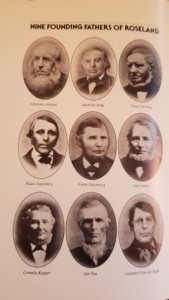
My great-great-grandfather, Jan, was 23 years old and single when he immigrated to the U.S. aboard the ship, “Massachusetts of Boston”, sailing from Le Havre, France in April of 1849. Jan was the son of Jan and Peterje (Stam) Ton, my great-great-great-grandparents. THEY had nine children. It was eight of their nine children who, over time, immigrated to the U.S. So, you can see how confusing that can get! The “Massachusetts of Boston” carried two Tons across the Atlantic, Jan and his married sister, Jannetje (Ton) Eenigenburg. Many of the families settled south of Chicago near Lake Calumet. Jan and eight other immigrants are considered the founding fathers of what is now Roseland, Illinois.
It appears from the records I can find there might have been some shenanigans going on onboard the ship. Jan and Aagje’s first son, Jan Jr. was born in February of 1850. Jan and Aagje would marry in 1853 and raise 14 children to adulthood.
The Underground Railroad
I am certain to have many more stories to tell as I learn more, but, I do want to relate a story that directly connects Jan and Aagje to the Under Ground Rail Road. The story is found in the 1923 book “The Wonder of the Dunes” by George A. Brennan. You see, what is now Indiana Dunes National Park was traveled by many freedom seekers on their way from Chicago to Detroit and on into Canada. The Hollanders settlement near Lake Calumet was a leading station along that portion of the underground railroad.
This particular story was retold many times over the years by Cornelius Kuyper, a dear friend of my great-great-grandfather’s and the town constable. Mr. Brennan records the story in his book. In his capacity as the constable, Kuyper was often called upon to assist in capturing run-away freedom seekers. He would attack each request with such zeal and effort, he would receive praise from slave owners and sheriffs alike…though…he never succeeded in capturing any freedom seekers.
A Story to Tell
As Kuyper tells the story, one day he was visited by a slave owner from Kentucky, a sheriff deputy from Chicago, and a posse. They were pursuing three freedom seekers, each with a $3,000 price on their heads. As was his norm, Kuyper searched high and low for the runaways, even taking the posse as far as the Illinois-Indiana state line. Once again, he came up empty-handed.
When they returned to Kuyper’s home, his wife Maartje prepared and served them a meal before they headed back to Chicago. After they were safely on their way, Kuyper headed into his cellar, opened a trap door, and summoned one of the freedom seekers who he had hidden away. He then went to the barn and moved part of an immense stack of hay, the other two freedom seekers emerged. He fed them, had them climb in his wagon covered them with cobs of corn, and took them to the home of Jan Ton. Jan hitched up his wagon, transferred the precious cargo, and headed out toward Indiana. Near the town of Hohman Bridge (today’s Hammond, Indiana), the cargo was transferred to another wagon. The freedom seekers were well on their way to Canada.
One can only imagine the countless times these men and women provided this service to others on their journey!
As I learn more, we will continue on this journey together. Until next time!
 In the twelve years, I’ve been writing this blog I’ve taken you on many journeys. This time it’s different. This time I don’t know where we are going. Join me as I explore. Together, we will explore the past, and maybe, just maybe, there will be some lessons for us today and in the future in the wake of the deaths of George Floyd, Breonna Taylor, Elijah McClain, and others.
 I’d like to give you a new image to consider for living on the edge. Many of you who know me, know I am a river rat. I would rather be canoeing a river than doing just about anything else on the planet. A technique for making your way downstream in turbulent waters is to use the eddies, those calm areas of water that form behind an obstruction. A canoeist or kayaker can enter the eddy, rest, regather, regroup, and scout the river ahead.
 31 of the 42 Division Commanders were replaced during or after the Louisiana Maneuvers. Among those new leaders? Dwight D. Eisenhower.
 (You knew they’d be in here somewhere, didn’t you?)
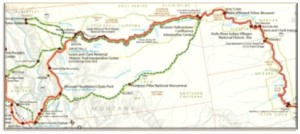 Pretty significant risk, wouldn’t you say? Dividing what was already a small Corps into four smaller teams and heading out into the still very much unknown? Call it taking risks, call it taking initiative. To be a leader, we have to know when to take these types of educated risks. History does not tell us about Jefferson’s reaction to this risk, nor do we know the “what ifs”. The decision could have lead to untold catastrophes. How would Jefferson have reacted if their journals had been destroyed, or if they had lost some of the precious discoveries, or if some of them had been killed? As leaders, not only do we have to be willing to take risks, but we have to provide an environment and a culture for our employees, leaders and future leaders, to be able to take risks, to be able to fail, and to be able to succeed.


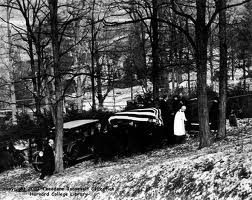 It was a cold, gray January day. The wind picked up the dusting of snow from the ground and flung it into their faces, stinging like needles. Tears froze to wind burned cheeks. The casket was slowly lowered into the frozen ground. A lone bugler played taps. Slowly, one by one, the people who had gathered, made their way down the 26 steps, down the long hill, and out of the cemetery until a lone figure remained. He stood motionless. His gaze locked on the hole before him. Tears stained his ruddy cheeks. His long coat flapped in the wind. His lips moved as if talking. Was he saying goodbye? Was he saying a prayer? Was he saying words of forgiveness to his now dead friend?