I’m sitting in my basement office while a hurricane of crepe paper and balloons gathers upstairs.

Earlier today, I picked up three of my grandkids from school and told them I had a “meeting.” They were instructed to help Grandma with “something.” We would have snacks after my meeting.

Based on the thundering overhead, it sounds less like three children and more like thirty.

Tomorrow I turn sixty-eight.

Upstairs, Carmen is trying — with all her heart — to surprise me.

It’s hard to surprise a man who signs for the deliveries, helps buy the party supplies, and manages the calendar. But that was never really the point. The point is the trying. The love poured into effort. The desire to make a moment sacred, even when logistics refuse to cooperate.

This weekend will hold laughter. It will likely hold tears. That, too, is our life. Joy and fragility inhabiting the same room.

 —  —  —  —  —  —  —  —  —  —  — 

And then she gave me the gifts.

Two bracelets — one that reminded her of the woman who watches over us. One tied to the country where my ancestors first learned to endure wind and water.

And then a compass.


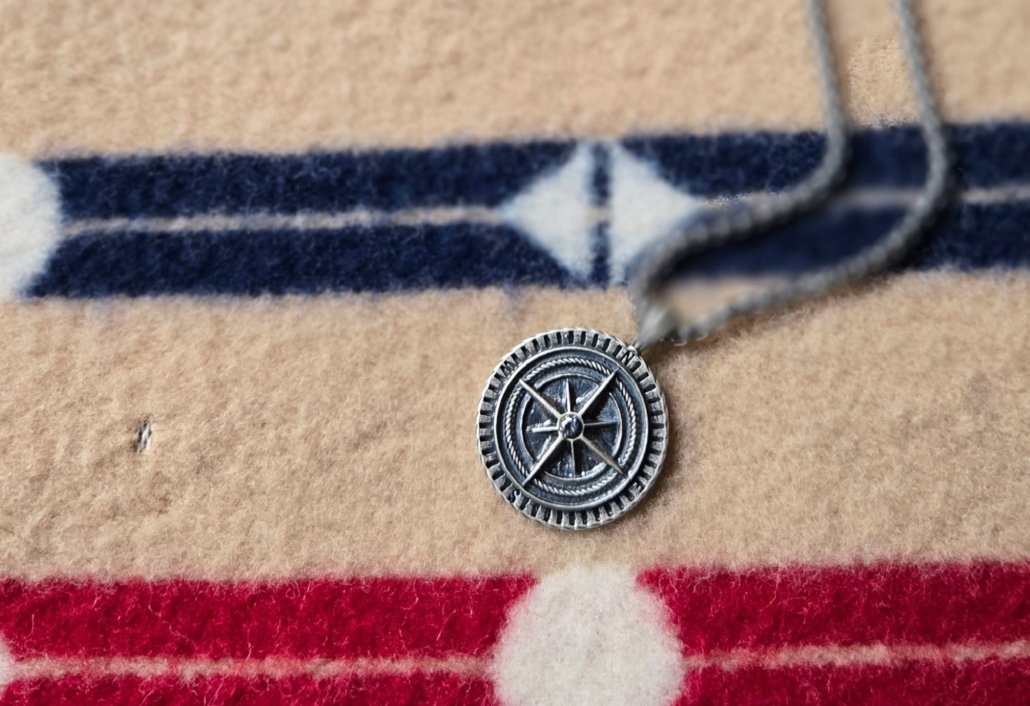
Sterling Silver Compass Pendant


A silver compass pendant on a simple chain.

Engraved not with a message, but with a place — the one we’ve chosen as our final camp beside the river.

When she told me what she had engraved, we both cried.

Not dramatically. Not loudly.

Just the quiet kind of tears that come when something true is spoken aloud.

Belonging.

Years ago, Carmen gave me a replica of William Clark’s compass. And a sextant. They sit upstairs now — steady and still — reminders that direction matters.

But once, we stood before Clark’s actual compass. Not a replica. His.

I imagined him under a hard sky, wind pressing against his coat, taking a reading and sketching a line with cold fingers. Beside me, Carmen had gone perfectly still — but not for the compass. She was studying a case of pressed flowers from the journey, the captains’ careful notes beside them. She traced the names as if reading a poem.

Native plants have always been her doorway.

Something shifted that day. She wasn’t simply accompanying me on an adventure anymore. She was inside the story.

Clark’s compass pointed west into conjectural territory.

This one does not.

This one points home.

When we first met, I wore a dream catcher around my neck. I even marked it on my skin. Back then, I was searching. I didn’t have language for it. I only knew there was something I hoped to find.

She was — and is — my dream.

And somehow, I caught it.

Now I wear a compass.

Not because I’m lost.

But because I know where we will one day lay down our packs.

 —  —  —  —  —  —  —  —  —  —  — 

A few minutes ago, my phone buzzed.

“Your meeting is over,” she wrote.

I climbed the stairs and was met by two grandkids nearly vibrating with excitement. They were far more animated about the surprise than I was.

Crepe paper hung crookedly. Balloons leaned against door frames. The house was louder than it needed to be.

And somehow, it felt hallowed.

The compass rests quietly at my throat.

The house is full.

I am exactly where I am meant to be.

blurred image of the cover - Uncharted Moments

The cover will come into focus at the end of the story!


People often ask about book covers.

They want to know about colors, fonts, and design choices—what the cover is “meant” to convey.

But for me, this cover was never really about how the book would look.

It was about how it would feel to someone who picked it up before they knew the story inside.

I didn’t want a cover that shouted.
I didn’t want something clever, busy, or loud.

Uncharted Moments lives in quieter places.

It’s a story about love that grows. About rivers, memory, and care. About the way life keeps asking us to listen more closely.

So the question I kept coming back to wasn’t Does this look good?

It was something simpler—and harder:

Would this cover feel like an invitation… or an interruption?

The cover matters deeply to me—but it only works because it grew out of what’s inside the book.

The maps that open each leg of the journey.
The way the story unfolds over time.
The photo gallery—not meant to impress, just to remind.
The space in the layout. Room to breathe. Room for the story to move without being pushed.

Those choices mattered because this journey was never about rushing from one destination to the next. It was about paying attention—to the river, to the land, and to each other.

So when I first saw the final cover design, what struck me most wasn’t what was there.

It was what wasn’t.

There was no urgency. No demand. Just a sense of movement. And calm.

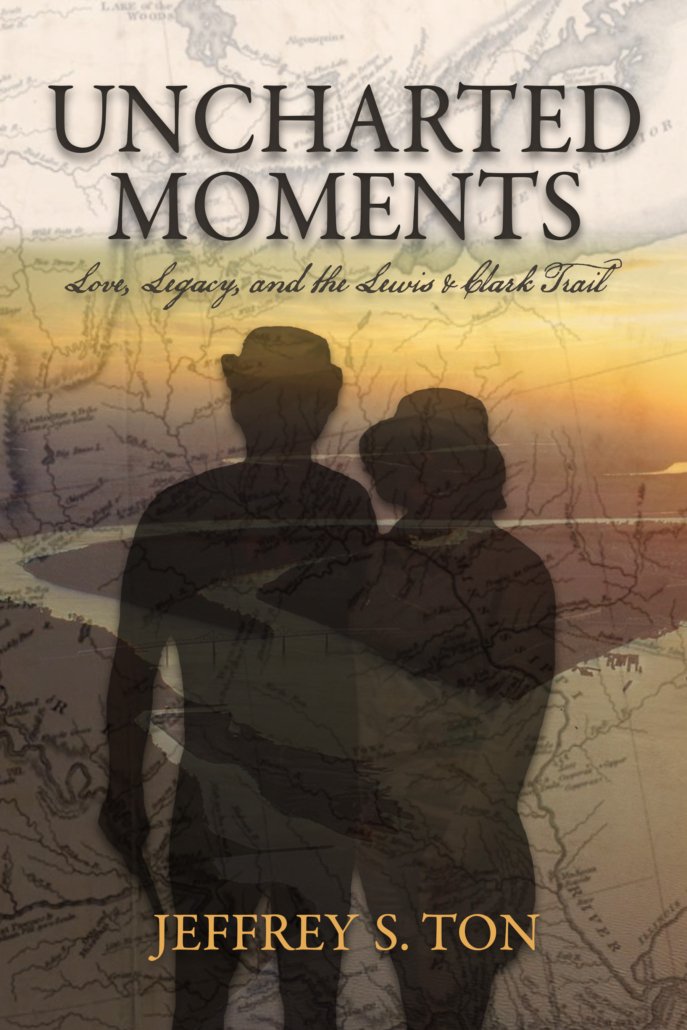
Later, after the cover was finished, my designer, Jennifer Vogel (“JVo”), shared what she had been thinking as she worked on it. What surprised me was how much she named—without me ever having said it out loud.

She wrote:

“The cover of Uncharted Moments was inspired by the powerful Missouri River and its confluence with the mighty Mississippi—they begin quietly, gathering strength along the way. Water teaches that meaning lies not in control but in adaptability, connection, and the courage to flow into the unknown.

When two distinct currents meet, they create something deeper, stronger, and more enduring. In the same way, Jeff and Carmen’s lives come together with both uncertainty and intention, shaping a shared journey neither could have charted alone.

Their love echoes the spirit of Lewis & Clark’s expedition—curious, courageous, and guided by faith in what lies beyond.”

When I read her words, I realized something.

The cover wasn’t just representing the book.

It was reflecting the journey itself.

Not a straight line.
Not a bold declaration.

But a confluence.

Two lives. Two stories. Meeting in motion.

So this isn’t really a cover reveal.

It’s more of a quiet acknowledgment—that the story inside has finally found its home on the outside.

And if this cover feels familiar to you…
or calming…
or like something you might want to sit with for a while…

 …then you may already understand what Uncharted Moments is about.

I’m glad you’re here.


cover - Uncharted Moments

Last week, I published “The Post I Never Wanted to Write.” As I was preparing to publish it, Carmen and I read through it several times, bawling our eyes out each time. When I hit “publish,” we didn’t know what would happen, but we wanted her story “out there.” We hoped the post would land gently. We anticipated some who read it to reach out. 

We received countless messages of kind, supportive words, of virtual hugs, and of offered prayers. What we didn’t expect was for the post to gather people. Many people shared their own stories of caregiving, of long-held grief and pain watching a loved one struggle, of gratitude for sharing our story so they did not feel so alone. 

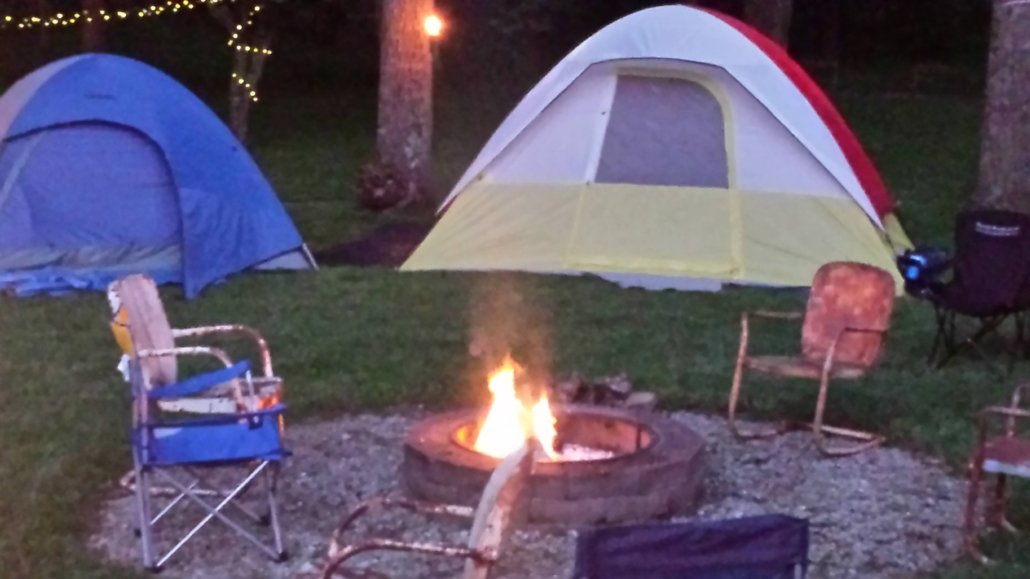
The image that kept coming to me was that of a campfire. Let me explain. In Uncharted Moments, I retell the stories of Carmen and me as we traveled the Lewis & Clark Trail. Many days, in fact, most days ended with us sitting beside a campfire. There we would quietly reflect on our day, on trials and the joys. To this day, we still do this at the end of each day. 

I think about Lewis and Clark and the people of the expedition. Every day was filled with toil, challenges, and hardship. But also new sights, sounds, and experiences. Each night, they would build a campfire and gather around. It was more than warmth to dry their wet clothing and warm their tired bodies. They told stories of the day, the fear of facing a grizzly, the pain of prickly pear cactus piercing their moccasins,the wonder of seeing thousands of bison, or the waterfalls, and the mountains. Those who could would journal. 

The river demanded everything by day. The fire gave something back at night. 

That’s what this week felt like. Not progress. Not answers. Just presence. 


What I thought was a single story became a shared fire.

Caregivers found each other. People told stories they’d been carrying alone. Some grief was new; some was decades old. 

The common thread wasn’t disease. It was love that refuses to leave. 

Resilience isn’t built by powering through. It is build by stopping long enough to be seen. 

Sometimes the bravest thing isn’t paddling harder. It’s sitting by the fire and telling the truth about the day. 

I’m glad I wrote the post. Not because it was easy. But because it reminded me that none of us are meant to carry these stretches alone.

The river keeps moving.

The fires keeps burning. 

For now, that’s enough. 

We proceed on — together. 

Looking back, I can finally see the shape of the river.


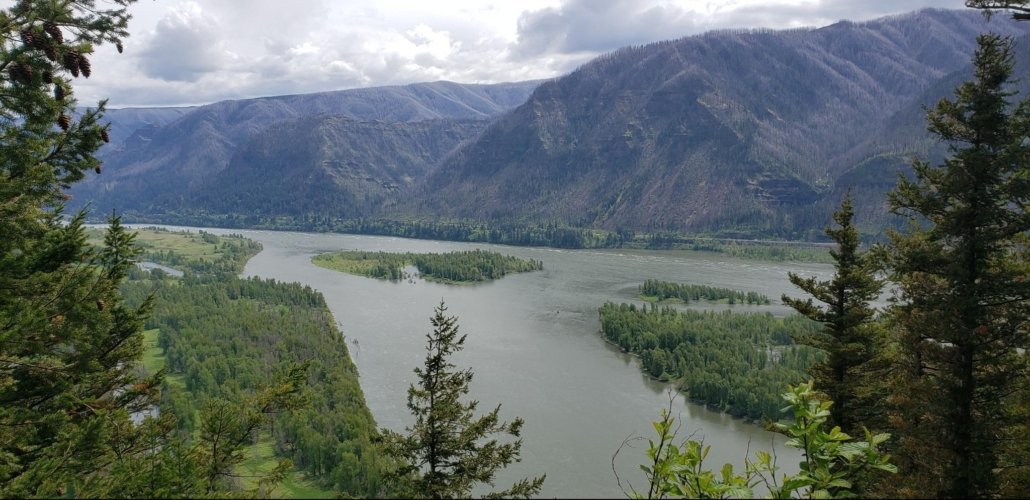
A sweeping view from above the Columbia River, where several channels bend and merge around forested islands. Rugged mountains rise in the distance under a soft, clouded sky, creating a sense of vastness, reflection, and quiet transformation.

The Columbia River — a reminder that every journey carries bends, convergences, and quiet shifts we only recognize from a higher vantage point.

I’ve been thinking a lot lately about how a person changes. Not in the dramatic, overnight sense, but in the slow, river-shaped way—quiet bends, steady currents, the kind of transformation you only notice when you look back and realize the landscape is different.

When I first launched this blog in 2008, I thought I knew what it would be. I wrote about sustainability, energy usage, water conservation, and the triple bottom line. I was earnest, a little intense, and deeply convinced that if we understood our impact on the world, maybe we’d take better care of it. Those posts were full of metrics, light bulbs, gallons saved, and carbon footprints. But even then, beneath the wattage and water usage, there were hints of something more: rivers, memories, my grandmother’s wisdom, and the first murmurings of Lewis & Clark.

I thought I was writing about ecology.

Really, I was writing about responsibility—about what we leave behind.


From CIO to Leadership to Storytelling

As the years went on, my writing followed the arc of my professional life.

I became a CIO, a tech leader, a mentor. I started speaking more, teaching more, writing about careers and culture and teams. Rivers of Thought evolved into a place for leadership insights and IT strategy. Those posts carried frameworks, lessons learned, and the familiar rhythm of someone who had lived through enough change to have something useful to say.

But even then—even in the middle of talking about cloud migration or executive presence—something else kept knocking at the door.

A long drive with the radio up too loud.
A river hike that left me breathless.
A memory of my boys.
A story about Carmen’s quiet strength.
A moment where leadership had less to do with business and more to do with being human.

Little by little, the edges between “work” and “life” blurred. The posts became more reflective, more personal, more rooted in places and people rather than roles and responsibilities.


The Turning Point I Didn’t See Coming

If I had to pinpoint the moment my writing turned, it might be Thanksgiving Day, sometime in the early 90s. The boys were with their mom. I was moping around the house when the phone rang.

“Dad, are you listening?”
“Listening to what?”
“Arlo!”

Before I could reach for anything, Carmen quietly went to the shelf, pulled out her own copy of Alice’s Restaurant, and put it on. No fanfare. No commentary. Just a small act of presence that aligned our lives in a way I didn’t yet understand.

Years later, when I wrote How Arlo Guthrie Saved My Life, I thought it was a one-off story about a song and a holiday. Now I can see that it was more than that. It was the beginning of writing from the inside out.

Not CIO.
Not even “leader.”
Just Jeff.
A man listening to the love, loss, wonder, and serendipity that shape a life.


The Era of Sacred Ground

The last few years have carried their share of joy and grief—losing my father, becoming a caregiver, watching life shift in ways I never imagined, standing in places that felt unexpectedly holy. I found myself writing about:

  • cemeteries and hallowed places

  • family stories passed down through generations

  • the Land of Serendip

  • rivers I’ve walked beside for decades

  • the Lewis & Clark Trail and the long arc of history

  • the quiet, steadfast love of my wife, Carmen

I didn’t set out to write like this.
It happened the way rivers happen—cutting deeper channels over time.

Somewhere along the way, my writing became less about managing change and more about making meaning. Less about leading others and more about listening—for what the land, the past, and the heart have been trying to say all along.


The Next Chapter: Storyteller, Keeper of Legacy

Now, as I move fully into this next chapter of life, I’m no longer trying to separate the strands.

I’m not just a former CIO.
I’m not just a leadership guy.
I’m not even “just” a writer.

I’ve become a storyteller—
of rivers and trails,
of love and serendipity,
of family and legacy,
of what it means to stand on sacred ground.

This blog has always evolved as I’ve evolved.
And I’m grateful you’ve walked with me through every shift—
from ecology to leadership to legacy to these uncharted moments I now write about.

If you’ve been here since the beginning, thank you.
If we’ve lost touch somewhere along the way, I hope this helps you see where I’ve been and where the writing is taking me now.
And if you’re new here, welcome to the river.

I don’t know exactly where the next bend leads.
But I do know I’ll keep telling the truth as I find it—
one story, one moment, one sacred place at a time.

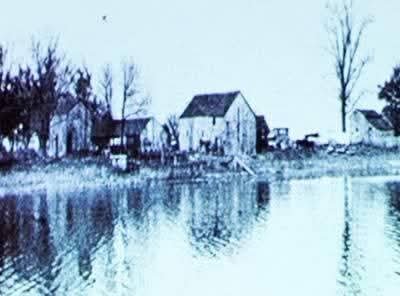
Jan & Aagje Ton Farm circa 1855

Ton Family Farm circa 1850

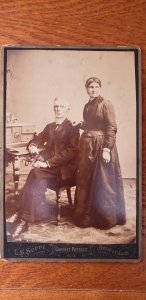
Last week, I stepped into a small Rotary meeting room to give a talk about something that has been quietly reshaping my sense of identity for years: my great-great-grandparents’ role in the Underground Railroad. It’s a story I’ve researched, written about, and carried with me — but this was the first time I’d ever stood in front of a group to tell it out loud, beginning to end.

I walked in with a laptop, a handful of slides, and more nerves than I expected.

I walked out with something else entirely.

Why This Talk Felt Different

Most of the time when I write about my ancestors, I’m alone — at my keyboard, on a trail, or standing near the Little Calumet River where Jan and Aagje Ton lived and worked and quietly helped people seeking freedom. Writing gives you the gift of revision. Space. Distance.

But speaking?

Speaking asks for your whole self.

Speaking means feeling the story in real time — where your voice catches, where the room leans in, where silence does the work words can’t.

As I prepared the talk, I realized I wasn’t simply recounting history. I was carrying something forward. I was giving breath to people who acted with courage in the shadows, never imagining their names would be spoken in a Rotary meeting room in rural Indiana more than 170 years later.

A Small Room, A Big Moment

There were twelve people.

That’s it.

Twelve chairs arranged around a few tables.

And somehow, the room felt full.

People listened — really listened. They asked thoughtful questions. They stayed after to share memories of their own family histories, to reflect on courage, to connect threads I didn’t expect.

“I grew up in that area — never heard those stories. Amazing.” 

“South Holland, huh? I remember going to the department store in South Holland.” 

“There is a house right here in Attica that was involved in the Underground Railroad.”

Small phrases. Stories.

Big impact.

There was no political edge, no tension — even though conversations about the 1850s can easily drift that direction. The room remained grounded in humanity, with its moral decisions, the risks ordinary people faced, and the echoes we still feel today.

In an era when much conversation occurs online, in all caps, with little listening, it was refreshing — even restorative — to be reminded that face-to-face, people are still capable of curiosity, humility, and grace.

The Lesson I Didn’t Expect

Preparing this talk took hours — more than I planned, more than I had, if I’m being honest. And yet, standing in that small room, I felt something shift.

It wasn’t about the PowerPoint.

It wasn’t about the delivery.

It wasn’t even about the applause.

It was the realization that these stories matter because they ground us. They remind us where we come from. They remind us of the ordinary people who made extraordinary choices. And they remind us that history is never as far away as we think it is.

I thought I was giving a talk.

Turns out, I was receiving one.

One Last Connection

A few days before the presentation, I read Sheila Kennedy’s post “Courage and Concession,” a reflection on political conflict in the 1850s surrounding the issue of slavery. The courage of my ancestors — and the courage of the freedom seekers themselves — settled in my gut. Her words stayed with me as I spoke, not because the Rotary talk was political, but because courage looks remarkably similar across centuries.

Sometimes it’s dramatic.

Sometimes it’s quiet.

Most of the time, it’s ordinary people doing the right thing when it counts.

My ancestors didn’t ask to be heroes. They just opened the door.

There’s something in that for all of us.

I ended my talk with these words: 

“And I think that’s what we’re all called to do in our own way — to open doors when we can, to tell the stories that remind us who we are.”

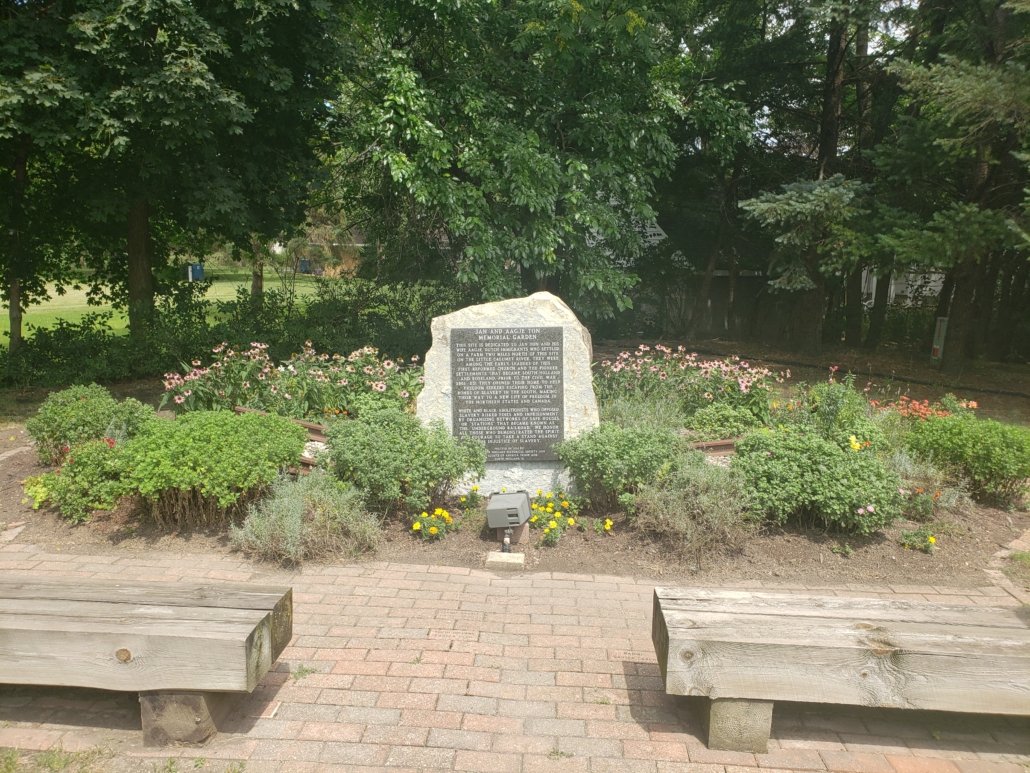
Ton Memorial Garden


If You’d Like to Follow Along

If reflections like this resonate with you — stories of history, legacy, and the unexpected ways the past reaches into our lives — I’d love to have you join my newsletter. That’s where I share the behind-the-scenes pieces I don’t post anywhere else. Subscribe in the side panel of this page. 

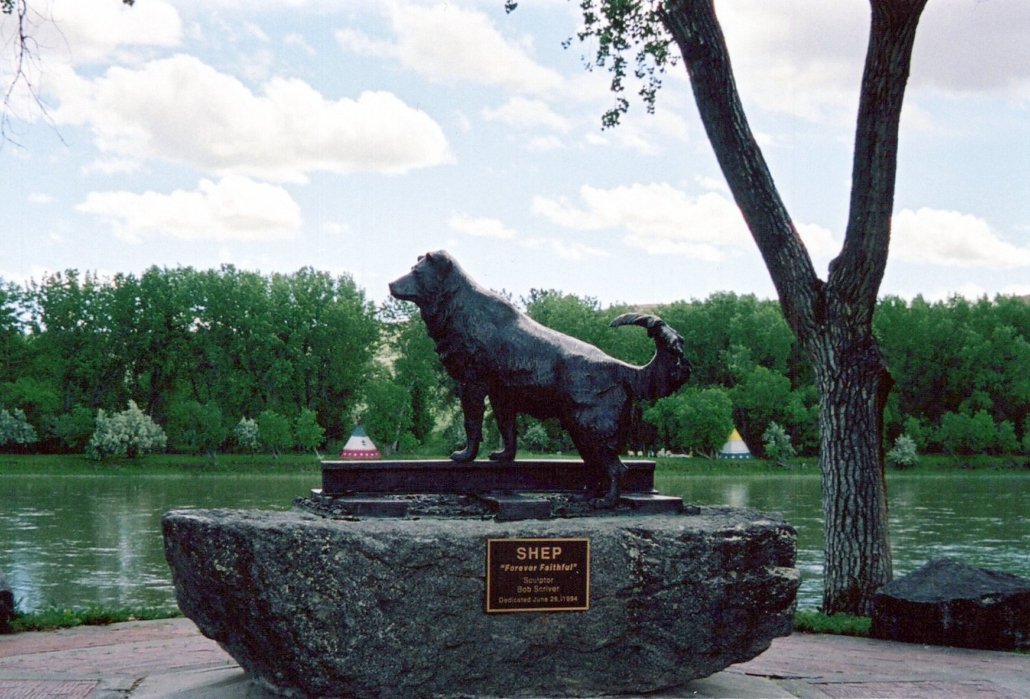
Shep - Patiently Waiting for His Master's Return

Shep – Ever Vigilant


Fort Benton wears the river like a well-earned badge. The Missouri slides past the levee with that steady, old-timer confidence—no hurry, no apology—shouldering stories you can feel even if you can’t name them. We parked, stretched road miles out of our backs, and did what we always do when we arrive anywhere along the trail: we listened. Not just with our ears, but with that other sense you learn on the water—the one that asks, What happened here, and who’s still holding the memory?

You don’t have to look far in Fort Benton. The brick storefronts, the iron bridge, the museum signs—they all point to lives stacked over lives. And there, near the river, is the town’s quiet heartbeat cast in bronze: Shep. Head lifted, ears set to a frequency I swear you can almost hear if you stand there long enough. The statue is beautiful, yes, but more than that, it’s attentive. It watches the place like a promise.

We learned the story—most visitors do—a dog and a depot. Loyalty stretched across too many days. Waiting that outlived an answer. Even if you only catch it in passing, the story tugs something in you that’s older than words. But that afternoon, the pull landed somewhere personal I hadn’t noticed before.

We read the plaque, circled the statue, and let the river do its slow work. The trick with places like this is to resist the urge to rush. You let your mind walk past the easy facts and settle into the grain. And in that space, Shep became less a legend and more a lens. Who’s keeping watch while we cross? Who’s marking the thresholds we don’t even recognize as thresholds until we’re on the other side?

A Second Shep

Back home, weeks later, I wrote the Fort Benton pages. I tried to capture the light on the water and the way that bronze posture lifted the afternoon into something like prayer. I tucked the scene among the rest of Leg 8—the miles, the small talk, the way a town on a river is never just a town. Then I slid the draft to Carmen.

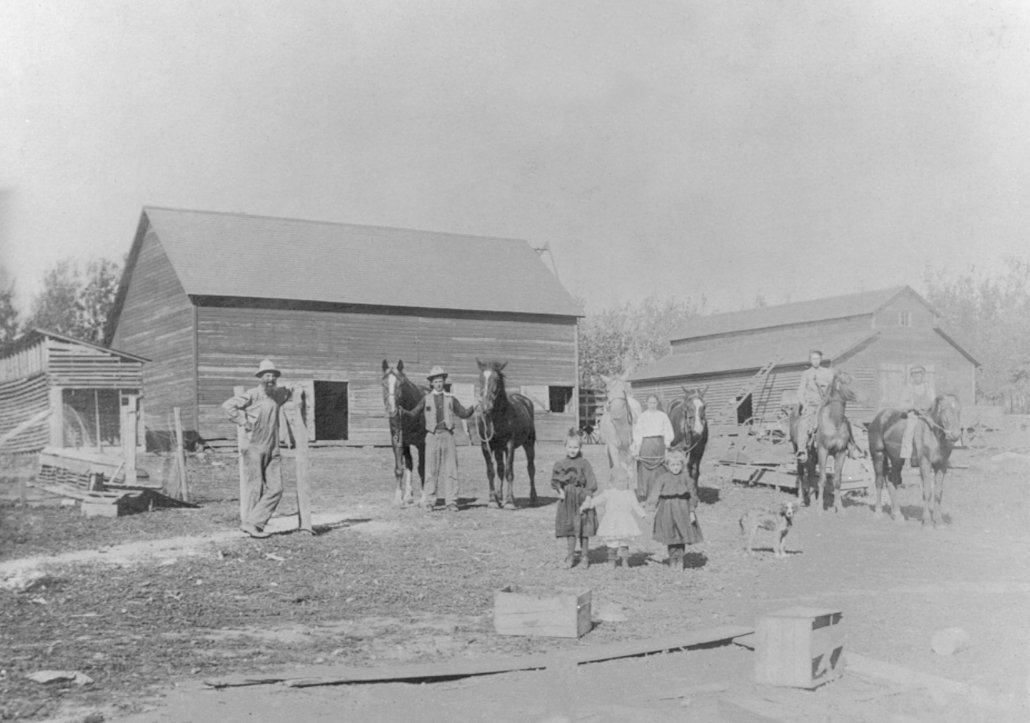
Hickey Family circa 1909

Hickey Family circa 1909 – Shep Front Right

Carmen proofreads like a cartographer—pencil steady, eyes tuned to terrain. She loves me enough to circle what’s true and underline what needs another pass. She also listens for echoes I miss. She was a few pages in when she looked up, soft smile, head cocked just a hair.

“You know your Granny’s dog was named Shep, too… right?”

The room did that slow-focus thing. I could hear the pencil roll to a stop. “What?”

“Your Granny’s farm dog,” she said, like we were both standing there in the yard already, like we’d just heard the back porch screen door slap. “Shep—it’s in her journals.”

There it was. Two Sheps, one in bronze beside the Missouri and one running fencerows in stories I grew up hearing without really hearing. A simple name becomes a through-line you can trace with your finger across a map of years. You think you’ve written a scene about a statue, and it turns out you’ve been writing about keeping watch your whole life.

I can see him now in the mind’s film—my Granny’s Shep—tan, with a white face blur at the edge of chores, tail sweeping the dust of a long afternoon. Whistle and he comes. Whisper and he hears. That’s what a shepherd does, even on a farm nowhere near a flock: he tends the threshold. He tells you when a stranger is coming up the lane. He walks with you to the barn at dusk and back to the house in the blue wash of evening. He is presence in motion.

Presence

And that’s what Fort Benton’s Shep felt like to me: presence. Not just the story tourists trade on the levee, but the way a place remembers for you when you’ve forgotten. The statue doesn’t just honor a singular dog; it blesses the job all guardians have—human or canine, living or gone—to stand at the crossings and keep an eye on us as we pass.

Carmen has always been the one to catch these threads. She did it in Paris when a bell peal turned “just friends” into something is happening. She did it in Louisville, at Mulberry Hill, when a small chain-link fence around forgotten graves felt louder than the big history down the road. She does it daily in our living room with a pencil poised over my prose. She doesn’t preach; she notices. Then she hands me the noticing like a found coin: This matters. Don’t walk past it.

Her Shep comment sent me back to the manuscript. I didn’t rewrite the scene so much as I recalibrated the listening. The river was still there, the afternoon still shouldered the same light, but the center of gravity had shifted. The statue wasn’t simply a point of interest on a Lewis & Clark-ish road day. It was an icon for a vocation that keeps finding us: stewarding what’s sacred as we move.

Sacred, for me, is not a word trapped in stained glass. It’s the living room where my grandmother’s stories breathe. It’s a town that builds bronze to say, We remember. It’s the Missouri’s hush beside a levee that has seen more arrivals and departures than any ledger can hold. It’s Carmen connecting dots I didn’t connect and, in doing so, knitting past to present so the cloth won’t tear.

If you’ve traveled with us in Uncharted Moments, you know we chase big landscapes and find small mercies. We go looking for history and discover our own hearts leaving breadcrumbs. Fort Benton gave us Shep twice—once in metal and once in memory—and both times as a gentle nudge: Pay attention at the edges. That’s where crossings announce themselves. That’s where love does its quietest, bravest work.

Thresholds

I’ve been thinking about thresholds a lot lately. The obvious ones—weddings, funerals, new jobs, last days—carry rituals we recognize. But the smaller ones shape us just as surely: a pause before you say the hard thing, a glance across a room that says we’re okay, a pencil mark in a margin that turns a “nice detail” into a seam you can pull. Maybe that’s why Shep lands so deep. He stands there without fanfare and makes the ordinary act of going from one place to another feel witnessed.

I don’t know what threshold you’re approaching. A decision you’ve been delaying. A phone call. A goodbye you didn’t choose. If I could hand you anything from Fort Benton, it would be the sense that you don’t have to cross alone. Somewhere nearby, there’s a keeper of the bend—someone or something that will sit within sight and wait until you’re on your way. Sometimes it looks like a bronze dog by a river. Sometimes it looks like a memory you thought you’d misplaced until your person says, Hey, remember? And sometimes it looks like the river itself, patient as breath.

When we left the levee, I turned once more to the statue and gave a small nod, the kind you give to an usher who helped you find your seat. Back in the car, Carmen squeezed my hand and returned to the pages. I drove with the Missouri in the corner of my eye, thinking about Granny, about dogs named Shep, about all the watchers who’ve kept vigil while we figured out our way.

We call them Uncharted Moments, these little collisions of place and past, because you can’t plan them and you can’t force them. You can only be there when they arrive. And when they do, you mark the spot—on a map, in a book, in your bones—and you carry on, shepherded by love toward whatever’s next.

— Jeff

P.S. Over the next few months, I will be sharing more from my upcoming book, Uncharted Moments Along the Lewis and Clark Trail – A Love Story. If you want to be in the know as it proceeds through the publishing process, sign up for my newsletter in the side panel of this page!

Jeff Ton - Lewis & Clark Experience: A New Way Forward


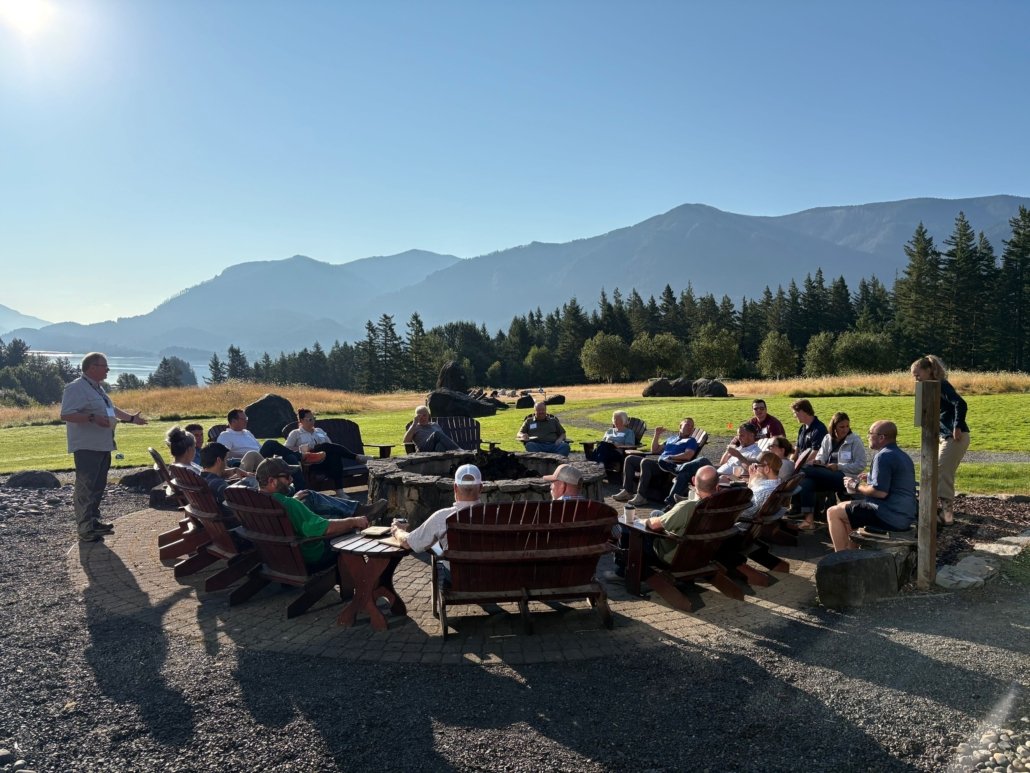
It happened at the cocktail reception before dinner. The sun was starting to drop behind the trees at Skamania Lodge, the white tablecloths on the garden patio lifting in the breeze, and the smell of dinner drifting across the lawn. One of the participants, beer in hand, approached. 

“So, I have a question for you. This morning, you asked about our “why”  — why we came to this program. What is your why? Why do you travel halfway across the country three or four times a year to guide this program?”

In five years, a dozen cohorts, and over two hundred participants, no one had ever asked me that.

I gave the first answer that came to mind: “I love the story, I love storytelling, I love seeing the lightbulb moments in people’s eyes when something connects.”

True enough. But the question stayed with me—over dinner, around the campfire that night, on the flight home. Why do I really do this? Especially now, when leaving Carmen is harder and harder with each trip.

Why – Deep Learning

I am honored to have been selected by my client, FCCS, to help build this program. What began as Carmen’s and my journey to follow the Lewis and Clark Trail blossomed into an entirely new career when Jean Canty Segal of FCCS read some of my writing about leadership and Lewis and Clark. She invited me to meet with a team of people in Seattle to discuss building the program. I was thrilled to be selected as a part of the team. 

It stretched me. I learned so much in those 18 months of developing the program. Not so much about Lewis and Clark, but about leadership development programs, experiential learning, and the discipline to bring their vision to life. I walked away from every meeting we had with new insights and new perspectives. 

From Sean Murray, I learned how to pace an experience so it flows.

From Matt Walker, I learned how the outdoors can carve a lesson deep into memory.

From Jared Nichols, I learned to stand in the future and imagine beyond the present.

My why? The learning never stops — and I love what we built.

Why – Continuous Learning

We launched the program in 2021, and since then, I’ve had the privilege of leading a dozen cohorts through the key concepts of Vision, Team Building, Overcoming Obstacles, Developing Resilience, and Proceeding On.

It never gets old. It never becomes routine. It never gets mailed in.

Each group arrives ready — hungry to learn, hungry to grow as leaders. They bond quickly and deeply. They are open to new and sometimes uncomfortable experiences. They push themselves. They challenge each other.

It’s a joy to watch it happen. Twenty strangers on the first night become friends, teammates, colleagues by the end of day one. They come from different industries, different parts of the country, different perspectives — yet they share a willingness to listen, to learn, and to support each other.

And I learn from every single one of them. Sometimes it’s an insight shared quietly after the hike or the aerial course. Sometimes it’s a reflection offered around the campfire, or a look across the table that says, Yeah, that makes sense now. Other times it’s a suggestion scribbled on a survey form (yes, we read every one), or a perspective I’d never considered, or a question no one had ever asked me before.

That constant exchange — giving and receiving, teaching and learning — is one of the things that keeps me coming back.

Why – Legacy

One of the leadership lessons we teach in the closing module is about legacy, not necessarily the legacy you leave behind when you leave this earth, but the legacy you leave behind in your team, in your teammates, when you transition to a new role or a new job. What do you hope they carry with them? 

I have grown so much through the program, sometimes taking to heart the very lessons I am teaching, perhaps in a different way. Like celebrating victories. As the facilitator, I too, need to celebrate victories, like the successful conclusion of another cohort. 

I have been thinking a lot about legacy as I approach the end of my career, as I move into the final chapter of life. What do I want to leave in the hearts and minds of others?

Family, of course. My wife Carmen — my partner in all things. Good times — tough times, through it all, I want her to carry my love in her heart. My sons, Jeremy and Brad. I see pieces of me in them — different pieces, similar pieces. Yet, they are their own men, teaching me each and every day. My grandkids  — Braxton, Jordan, Jasper, and Hayden, step grandkids Ari, Avery, and Henry, and step grandkids from a son’s prior marriage, Donny and Charity. Legacy.

The Indiana CIO Network. A group of IT professionals across Central Indiana and beyond. What started as five colleagues having lunch has grown into a group with over 400 members. Each member brings their insights and expertise  —  and their willingness to share and support each other. A new group of leaders have taken the reins and the group is thriving! Legacy. 

The Lewis and Clark Experience: A New Way Forward. There will come a time when I no longer serve as a guide for the program. Having the program on a solid foundation is one of the reasons I have poured my heart and soul into it. It is why we fine-tune it almost every time. That’s why I rehearse until I can forget the script and speak straight from the heart. Legacy.

The Journey

When Carmen and I first set out to follow the Lewis and Clark Trail, we had no idea what we’d discover. It became the theme of our life, the shape of my career, and the heart of my next book — Uncharted Moments Along the Lewis and Clark Trail – A Love Story.

I suppose that’s my real why: to keep the story alive — for the people in the room, for the people I love, and for the people I’ll never meet.

— Jeff

P.S. Over the next few months, I will be sharing more from my upcoming book, Uncharted Moments Along the Lewis and Clark Trail – A Love Story. If you want to be in the know as it proceeds through the publishing process, sign up for my newsletter in the side panel of this page!

I couldn’t tell you my earliest memory of hearing church bells. I can only tell you, as the son of a preacher, my guess is I’ve heard church bells most of my life. Growing up in a small town in the Midwest, I remember hearing the bells tolling every hour on the hour…and at noon, they would play a short song, er uh, hymn. There is something about playing outside on a warm summer day with bright blue skies and hearing the bells reverberate through town. It’s kind of like baseball and apple pie.  

I do remember our annual visits to the Green Lake Conference Center (or just Green Lake as we called it) and the carillon chiming high atop Judson Tower. The peals could be heard across the grounds and from the lake. Trekking the 121 steps to the top of Judson Tower rewarded you with an experience you could feel from the top of your head to the tips of your toes! 

When I was in high school, I joined the handbell choir at church. We made some beautiful music if I do say so myself! Our choir became fairly well known in town and we were able to play some high-profile concerts. We made some incredible music…even this old rock and roller has to admit that!

Today, our house reverberates with chimes (bells) from a cuckoo clock, outdoor windchimes, and my grandmother clock (my mother’s clock and she insisted it was NOT a grandfather clock, it was a grandMOTHER clock!

All of this is to tell you why I had to make an extra stop on my most recent trip to Chicago. I had to see the bell. What bell, you ask? Well, let me tell you the story…


Great-Great-Grandfather and The Bell

In 1849, a group of families immigrated from The Netherlands to the south side of Chicago and settled in what is now called Roseland. They called the area High Prairie. These Dutch were devoted members of the Dutch Reformed Church. Soon after their arrival, they founded the First Reformed Church of Roseland. 

By 1867, the church had outgrown the house they had been using for services and decided to build their first church building. The frame church at 107th and Michigan Avenue included a wonderful steeple and belfry. Wonderful…but empty.
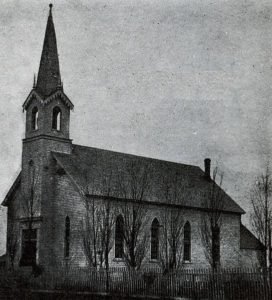
First Reformed Church of Roseland

According to my great-great-aunt Neeltje (Ton) Jansen, daughter of Jan and Aagje Ton (my paternal great-great-grandparents), this bothered her father to no end. As one of the church’s founders, he took it upon himself to raise money for the bell.  He donated the first $100 and, in a short time, had the $300 they would need to buy a bell (that’s about $6,500 in today’s dollars). As he collected the money, he gave the money to Aagje, who hid it in an old beaded bag and put it in a drawer for safekeeping. 

One night, long after dark, two men knocked on the door asking for directions. When Jan stepped out to point the way, they hit him in the forehead with a slingshot. The two attackers held him down and demanded the money. Bleeding profusely from the wound, he led them to a closet and gave them the money from his trousers. The men knew he had been raising money for the bell and knew there had to be more. They beat him, threw him in the closet, and locked the door. They then proceed to ransack the house. Pour Aagje was confined to her bed, just having given birth two or three days prior, she hid the other children with her and waited. Finally, the men gave up and left. Though they rummaged through the drawer containing the money, they failed to realize the beaded bag contained what they sought. 

The very next day, Jan sent the money to Troy, New York, to pay for the newly founded bell. 

Our story does not end there.

The Bell Arrives

About a month later, Jan received notice that the bell had arrived in Chicago, he tied his team of oxen to the wagon and rode the 20 miles to the small town along the lake. Possibly to the same port he and his family had arrived at 18 years before. 

Three days later, Aagje had not heard from Jan. Distraught, she asked two neighbors to search for him. They found his wagon bogged down in the mud and the bell lying half-buried in the muck near The Eleven Mile House Tavern (92nd and State Street). When they found Jan, he recounted the ordeal of getting stuck in the mud with the heavy bell. His efforts to free the wagon tipped the bell into the mire. Since he was alone, he could not lift the bell back onto the wagon, so he just decided to wait, thinking, “Someone will come looking sooner or later.”

The men rescued the bell and a week later, it was hung in the belfry and called its first worshippers to services. 

Visit to The Bell

That was my extra stop…to see the bell. Although a distant cousin had sent me pictures of the bell, I had to see it myself! The bell rang in the belfry the First Reformed Church of Roseland at 107th and Michigan Road until the church built a much larger facility in 1887 just south of the intersections at 107th Street. The bell was later moved to the First Reformed Church of Lansing (Illinois). Today it is on display at Thorn Creek Reformed Church in South Holland, IL…or is it? 
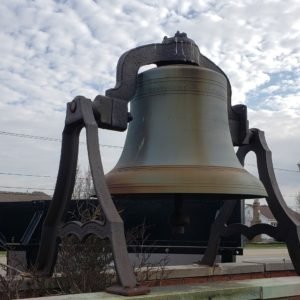
The Bell?

It is now a few weeks after my visit. I knew I wanted to tell the story of the bell. As I wrote, I kept referring back to the pictures I had taken that day, the book about Roseland Down an Indian Trail in 1849 by Marie K. Rowlands, and the story my great-great-aunt had written in 1932. Something was off, but I wasn’t sure what. Then I saw it. The bell at Thorn Creek certainly was forged in Troy, New York as Ms. Rowlands wrote in her book…but the date…the date forged in the bell was 1887…- 1887, not 1867.
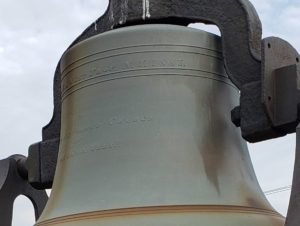
The Date?

So, I began pulling on threads. Those threads led me to research five churches, two foundries, and the history of the Dutch Reformed Church and its various successions and splits. 

The First Reformed Church of Roseland did, in fact, build a new larger building in 1887. It seems they must have ordered a new bell for the new facility. The original bell, no longer needed, made its way to the First Reformed Church of Lansing (Illinois). A brother-in-law of Jan’s helped to found the Lansing church. Perhaps that is why the bell was gifted to them?

The Fire

The Lansing church built its first building in 1897. That building burned to the ground in a huge fire in 1945. Newspaper articles from the time describe the steeple (and the belfry) crashing down into the street. An eyewitness, who was ten at the time of the fire, remembers the sound the bell made as it slammed into the roadway. 
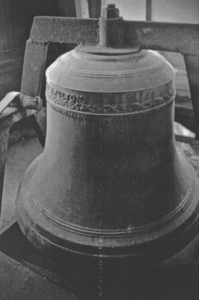
THE Bell
Photo: Daniel Bovino

The congregation raised money and built a new building on the same spot. Two area historians believe the bell hanging in the belfry of the new building (completed in 1947) is the “Ton Bell.” If it is, it creates another question. Cast into the bell is the name of the bell founder, “A. Fulton.” I cannot find any reference to a bellmaker in Troy, New York, by that name. I can, however, find a renowned bellmaker who had a foundry in Pittsburgh, PA, in the 1800’s. Could the author of the “Indian Trail” book have made a mistake when she wrote, “Ton dispatched the money to Troy, New York with an order for the bell”? That now seems likely.

As for the 1887 bell that is on display in front of the Thorn Creek Reformed Church, how did that bell find its way there? It is clearly cast for the First Reformed Church of Roseland. The answer is less of a mystery than I thought. You see, the Thorn Creek church IS the Roseland church. The church moved to South Holland in the early 1970s. I assume, since there already was a First Reformed Church of South Holland, they named themselves Thorn Creek. 

Sometimes when you pull on threads, you confirm the past, sometimes, you reach a dead-end, other times, you gain new insights that rewrite the story. I will keep pulling on threads…


The First Reformed Church of Roseland, IL

  • established 1849,
  • Original building built 1867
  • “Ton” Bell Purchased circa 1868
  • New building built 1887
  • Second bell (now at Thorn Creek) cast 1887 
  • moved to South Holland, IL circa 1971

The First Reformed Church of Lansing, IL, established 1861, today called Lansing First Church PCA

  • original building built 1897
  • “Ton” bell hung in belfry
  • Building destroyed by fire 1945
  • New building built 1947
  • “Ton” bell hung in new belfry

The First Reformed Church of South Holland, IL

  • established 1865
  • Reorganized 1886
  • Site of the Jan and Aagje Ton Memorial Garden 2013

Thorn Creek Reformed Church, South Holland, IL

  • First Reformed Church of Roseland relocated to South Holland circa 1971
  • Home of the “second” bell from 1887

Lilydale Progressive M.B. Church, Roseland, IL

  • Bought the building built in 1887 from the First Reformed Church of Roseland when they moved to South Holland and became Thorn Creek circa 1971



Continue with me on our journey, A Journey Through the Land of Serendip. You may recall from the first installment (and if you don’t you can read it here), this past summer two separate storylines from this blog collided in a wonderful adventure. That adventure continues here…and collides with a third storyline…a storyline I have yet to write!

After spending a magical afternoon on Chicago’s south side in the communities of Roseland and South Holland, we continued our journey north toward the Green Lake area. Green Lake, more specifically, the Green Lake Conference Center has always held a special place in our hearts. In the post, Shadows of Days Gone By, you can read about our family’s ties to this slice of heaven-on-earth (and no, that is not the collision of the third storyline). In 2014, we added to the legacy when the family had gathered lakeside to scatter my mother’s ashes near one of the pergolas on Memory Lane. This was our first return since that day. 

A Journey Through the Land of SerendipOne of the things both my parents loved to do in their later years at Green Lake was to explore the Amish communities south of the lake. Carmen and I had explored these areas many times during our visits with them. Brad, now 37, had never had the experience. I was excited when he decided to join us on the trek. We would honor my parents by visiting the Amish Pleasant View Bakery and indulging in fresh, warm cinnamon rolls as big as your head; shopping at Mishler’s Country Store; and, stocking up on enough cheese for a year at the Kingston Creamery. Gene and Mary Ellen would have been proud! 
Later in the morning, we arrived at the Conference Center. Even after being away for seven years, I got the same ol’ feelings driving through the gates and down the main road. Memories of dozens of visits. Warm, pleasant memories. Family. Friends. Adventures galore. Brad had plans to honor his grandfather the best he knew how…by playing a round of golf at Lawsonia, the world-class course located right on the grounds of the conference center. It was his “Popper”, my dad, that first introduced him to golf. 

Throughout the years whenever my kids and I or my sister and her kids visited, Popper would take them golf ball hunting. You see, Lawsonia is a tough course. I always felt like I had a good round if I only lost a handful of golf balls during a round. The grandsons loved their time hunting with Popper. Later as they got older, he would take them for a round. Brad loves golf. I think he always felt closest to my dad when they were playing! “Good one, Brad!”, “You really walloped that one, Brad”, “Keep an eye on where it goes into the woods, Brad” (hey, not every shot can be a good one!). 

“Still no collision of the third storyline”, you say? I know, I know, I’ll get there, I promise! 

We dropped Brad off at the course and Carmen and I headed into town to check-in to our hotel and visit the annual art festival that happens every summer (another favorite of Mary Ellen…not sure about Gene). After a couple of hours of shopping, we picked up Brad and headed out to dinner at another Gene-and-Mary-Ellen-later-in-life-favorite, Norton’s Restaurant. At dinner, we shared stories. Stories of our times at Green Lake…of our times with mom and dad…times with dad, Popper, Gene, the Reverend Doctor Ton. 

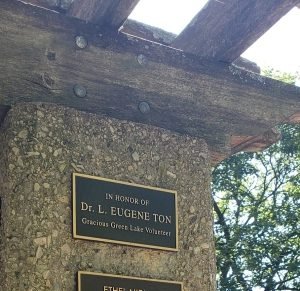
Sunday morning, we picked up Brad from the BNB where he was staying and headed, once again, to the grounds of the Conference Center. A worshipful silence fell on us as we got out of the car and walked to Memory Lane. We wandered along the walkway through the plaques and memorials to Baptist leaders of the last half-century or more. Pergolas offer shade and benches for reflection. They too are covered with plaques. Without speaking we each in turn separated ourselves from the others to be alone with our thoughts. We discovered and re-discovered a plaque to mom, a plaque to both mom and dad, a plaque to dad, finally stopping at the last pergola. 
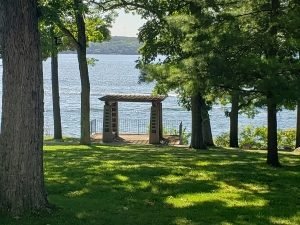
This was the place. On the pergola was a plaque honoring my grandmother and grandfather, my mother’s parents. This was where we had gathered seven years ago. My dad, siblings, my aunt, and some friends. This was where we each said our goodbyes to mom as we scattered her to the wind and the water. Of all the life moments I have documented in this blog, I don’t think I have ever written about that day. As I think of that day now, that will be a story I need to write. What is important for our story today is what dad used that day. 
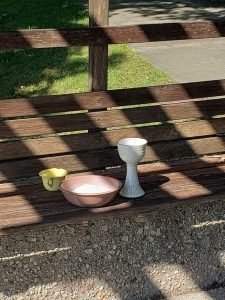
As we approached the pergola in 2014, dad had a large brown bowl filled to the brim with, well, with mom. I immediately recognized the bowl as one we had used often growing up…mostly to serve mashed potatoes. Beside the bowl was a yellow measuring cup. This was the measuring cup mom had used to fill her iron with water. THAT is what dad had selected to use for this somber, bittersweet time. (uh, one of the early signs of the dementia that would later take him over). Rather fitting for a family that relied on humor and sarcasm to share its feelings! 

During one of the downsizings dad would endure in the ensuing years, Carmen saved those two precious items. It was into that brown bowl I now poured dad’s ashes. We would use the same yellow measuring cup to scoop him up and scatter him to the wind and water. To these, we added a chalice to share in communion. For years, our family would pass the cup to mark significant moments in our lives…a marriage…a birth. Forty years ago, we passed the cup surrounding mom’s hospital bed as she lay near death from a devastating fire. 
Brad, Carmen, and I stood in the pergola. I read the eulogy I had shared at dad’s funeral (honestly, it was easier to read at the funeral than it was in those moments…” Niagra Falls, Frankie”). In turn, we each remembered dad/Popper in our own words, sipped from the cup, took a scoop, and scattered him into the breeze with the sun sparkling off the surface of the lake. We then took a scoop in honor of each of the family members who could not be with us that day and scattered them. Dad was now with mom. 

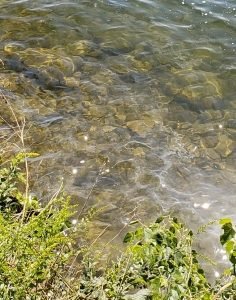
As I gazed down the bank, I noticed some of his ashes had filtered through the shrubbery on the bank and landed in the water. As the waves were rolling into the bank, the ashes were dispersing on the surface. It looked like wisps of smoke as the tendrils of ash spread. I snapped a picture with my phone. 
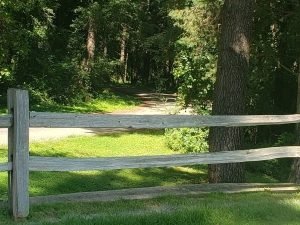
Once we completed our goodbyes, we quietly walked back to the car. (I cannot confirm nor deny that we saved a scoop to scatter at the 8th hole tee box on the Links course at Lawsonia). The three of us then spent time exploring the grounds, sharing stories, climbing Judson Tower, sharing stories, walking the lakeshore, and, yes, sharing stories. We left the grounds not knowing when or if any of us would return. 
“Uh, but what about the collision?”

The next morning as we were preparing to leave and head home, I was sitting on the balcony sipping my coffee while Carmen got ready. I took those moments to check my email. On the drive up, I had received an email from my graphics designer extraordinaire. 

For the past several months I had been working on a new book project. A labor of love. I am releasing the 2nd edition of a book my mom wrote forty years ago. In 1980, mom was almost killed in a fire. She survived. Not only did she survive, but she also wrote a book. The Flames Shall Not Consume You is a book about her journey through the fire, its aftermath, and her wrestling match with God. My own journey to publishing this book has been an incredible journey of love, friendships old and new, and serendipitous moments (remember we are traveling through the Land of Serendip). 

My designer’s email contained some sample cover designs. I opened the first one. The collision took my breath away. Her cover design was that of a flower on fire. As the flower burned, wisps of smoke extended from the flames. Wisps of smoke spreading into the air…smoke… smoke spreading across the water. I pulled out the photo I had snapped yesterday of dad’s ashes on the surface of Green Lake. The tendrils of smoke were a perfect overlay for the cover image. Chills ran down my spine. Tears ran down my cheeks. 

A collision of epic proportions. Three storylines come together on a balcony in Green Lake, Wisconsin. The Land of Serendip, a series of fairy tales telling the story of my dad’s battle with dementia; A Journey, a series about the discovery of my great-great-grandparents’ involvement with the Underground Railroad; and the, yet to be written series, The Flame Burns Brightly, relaying the journey of bringing mom’s books back to life.

Related Posts:

A Journey Through the Land of Serendip [Part I]

Serendipity – A Fairy Tale

The Land of Serendip Revisited

The Land of Serendip – The Final Chapter

A Journey 

A Journey Continues

Welcome to the collision of two storylines. I don’t know how often this happens to other authors, but I believe this is a first for me in over a decade of blogging. A few years ago I wrote a series of posts in the form of fairy tales. The fairy tales took place in a magical kingdom called Serendip and were a way to convey the story of my father’s declining health. The final installment was written just a few days after his death in December of 2019. Last year I started another series titled “A Journey” after I made a surprising discovery about my great-great-grandparents. I learned they operated a stop on the underground railroad for a number of years. I promised to continue to provide updates as we discovered more of the story. Those two stories came together this past summer. 

Even though the title of the third installment of the fairy tale series was “The Land of Serendip – The Final Chapter”, it was not the final chapter. My father’s wish was to have his ashes scattered in Green Lake, Wisconsin where we had scattered mom’s ashes in 2014. Our plans to make that trek in the summer of 2020 were derailed by, yep, the global pandemic. We put our plans on the shelf, well, actually, we put dad on the shelf…literally. 

A Journey Through the Land of Serendip

Jan & Aagje Ton

Early in the summer, we made the discovery about my great-great-grandparents. That prompted me to write the “A Journey” series. Fast forward to the summer of 2021. We began to make plans to take dad to be with mom. Our plans included a stop in South Holland, Illinois, to visit the site of the Jan and Aagje (pronounced ahk-e-ya) Ton Memorial Gardens. Jan and Aagje are my great-great-grandparents. In June, almost a year to the day since I posted the first installment of that series, Duane DeYoung left a comment on the post. He, too, is a descendant of Jan and Aagje. 

A few weeks later, I received a letter, yes, an actual letter. The return address was the South Holland Historical Society. Curious, I tore open the envelope. Inside was a letter from Robin Schedberg, she, too, found my post. She was writing to let me know about a rededication ceremony to commemorate the tenth anniversary of the memorial garden. The ceremony was scheduled for October 16th. The same date as my…well, I’m not saying which one, suffice it to say I am old…high school reunion five hours away in the opposite direction. Over the summer we texted and emailed several times. Robin sent some wonderful photographs of some historical pieces they have in the Society library. 

We toyed with the idea of delaying our trip to scatter dad’s ashes until October but given the conflict with the reunion and the fact that October is the off-season for the Green Lake area, we decided to move ahead with our plans for an August trip. Our itinerary included a stop in South Holland to meet local historian, Larry McClellan, view the memorial, and tour the area. We would continue to Green Lake, spend a couple of days, scatter dad’s ashes and then return home. At the invitation of Duane DeYoung, we planned to stop by his home in Wisconsin on our return trip. 

Days before we were to embark on our adventure, Duane wrote saying he had been in contact with Robin and she could meet us on Monday afternoon in South Holland. It had not occurred to me to share our full itinerary with him. I picked up the phone and called him. Imagine that a letter and a phone call in the same story! I explained Larry’s availability was limited to Friday and we were planning to meet him at the memorial site. A day or so later, Duane let me know that he and his wife June would meet us at the site on Friday, and we were still more than welcome to stop by their home the following Monday. 

With that preamble, welcome to “A Journey Through the Land of Serendip”. Friday morning, August 13th, my wife, Carmen, my son, Brad and I loaded the car and headed north. Oh yeah, dad was with us too, but he didn’t help load the car. I can’t tell you how many times one of us asked, “so, do we have dad?”. No one wanted to drive all day without the guest of honor! 

Trying to coordinate a meetup on the South Side of Chicago, when one group was coming from Indianapolis (three hours away), another group was coming from Lake Geneva (a couple of hours away), and the tour guide, although local, on a tight schedule was a little tricky, especially when Chicago traffic can change in an instant. What did we do before text messaging, GPS, and traffic apps? We arrived at the memorial a few minutes before the appointed time. The memorial sits on the grounds of the First Reformed Church of South Holland, somewhat apropos considering my father was a minister. We learned that Jan had been one of the founders of the church and served as a Deacon for a number of years. That was one of the reasons for selecting the site, and one of the reasons Jan and Aagje were selected to be honored and remembered. 

A Journey Through the Land of Serendip

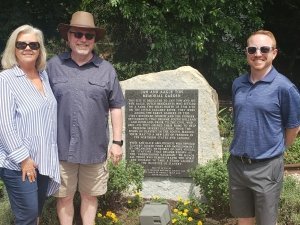
Carmen, Jeff & Brad Ton

Hoping to have some private time at the memorial, we were a little disappointed to see a woman tending the flowers in the garden surrounding the monument. Our disappointment was short-lived as once again the magic of serendipity struck. The woman tending the flowers was Nadine Harris-Clark, the aunt of LeRone Branch, the Eagle Scout who was the force behind the memorial.  We soon learned, Larry had given her a heads up we would be there. Not only did she want to meet us, but she also brought a photo album of the building of the memorial. She was beaming with pride as she talked about the project, the care that had been taken to select plants native to the area to surround the monument, and her nephew LeRone.  

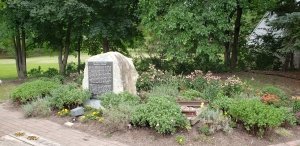
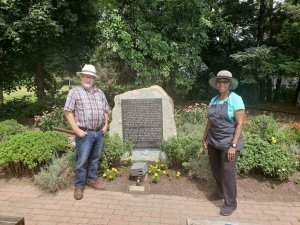
The memorial itself is a 9,000-pound piece of granite. We had seen pictures of the gardens and the stone the previous year when we discovered this amazing story. What was hard to see in the pictures were the railroad tracks that ran under the stone as a symbol of the underground railroad. The scene was breathtaking. The tracks seemed to emerge from the native flowers, disappear underground, and reemerge on the other side of the stone, only to disappear again in the flowers. We were all near tears as we took it all in. 

A Journey Through the Land of SerendipLarry soon arrived, followed shortly thereafter by Duane and June. Let the reunion commence! Larry has been researching the history of the area, the Tons, and the Underground Railroad for years. He has written numerous articles and books on the subject. We stood near the monument while he shared the history with us. He believes between four and five hundred Freedom Seekers passed through this area on their way to Canada. “They had to leave the land of the free, to become free”, he stated. 
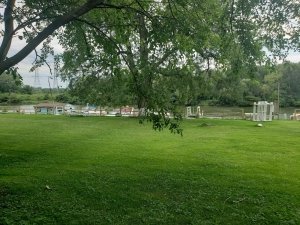
Freedom Seekers would travel north from Missouri, western Kentucky, and parts south, along the Mississippi and the Illinois Rivers and then overland to Chicago. Arriving in Chicago, they would rest before heading south around Lake Michigan and on to Detroit where they would cross into Canada. It was on the southern trek around the lake they likely encountered my great-great-grandparents. Jan and Aagje owned a farm on the northern shore of the Little Calumet River. They would hide them, feed them, provide them a place to rest, and then help them on their way to Indiana. They had purchased the farm from George Dolton, who operated first a ferry then a toll bridge over the river. It is likely Dolton who directed many of the Freedom Seekers to the Ton Farm. 

After the history lesson, Larry, Duane, and Brad crammed into the backseat of our SUV and we drove to the location of the Ton Farm. Larry continued our history lesson as we drove, identifying this road and that road as old Indian trails and routes Jan would have taken to get to Indiana with his precious cargo. We crossed the river at the Indiana Avenue bridge. This would have been where Dolton’s toll bridge once spanned the water. 

A Journey Through the Land of Serendip

Location of the Ton Farm

Chicago’s Finest Marina now sits on the site of the Ton Farm. The owner of the marina, retired Chicago Police Officer, Ronald Gaines, was unable to meet us and the gates were locked. We took turns peering through the iron gate at what would have been the location of the Ton home. The farm was originally 40 acres, so we walked a gravel road that ran along the river. It was an incredible feeling to walk where my ancestors would have walked 170 years ago and to peer out on the river they peered upon. 

Larry shared the Little Calumet River Underground Railroad Project was a group of volunteers who are researching the area and identifying historical places of interest. They are creating a water trail down on the river and will be placing markers, one of which will be at the Ton site. Being avid canoeists in our younger days, we are looking forward to paddling the trail! We piled back into the car and headed back to the Church, not before stopping on the Indiana Avenue bridge so Carmen could take a picture looking from the bridge to the farm a short distance downstream. 


Once back to the church, we bid adieu to Larry and Nadine (who was still there tending to the flowers). Duane and June left to meet Robin at the library. We needed to continue our Journey Through the Land of Serendip.

A Journey Through the Land of Serendip

Larry McClellan & Nadine Harris-Clark

Without having to give a spoiler alert for the continuing series, one of the things I need to share is the uncomfortable feeling I get every time we thank someone associated with the memorial project for creating this monument to Jan and Aagje. Why uncomfortable? Because when we thank them, they thank us for what Jan and Aagje (and others) did 170 years ago. We are honored they chose to remember Jan and Aagje. We are honored to be descended from Jan and Aagje. 

Related Posts:

Serendipity – A Fairy Tale

The Land of Serendip Revisited

The Land of Serendip – The Final Chapter

A Journey 

A Journey Continues