When you read my upcoming book Uncharted Moments, you’ll see pretty quickly that I love rivers.
They run through the entire story — literally and metaphorically. Confluences. Currents. Crossing points. Sacred ground near water.
But that love didn’t start the way you might expect.
It started with mosquitoes.
—————————————————————————————————————————
In the summer of 1992, my oldest son, Jeremy, and his church youth group decided they needed a “real adventure” for their annual trip. That’s how I ended up in the Canadian wilderness as a chaperone on a week-long canoe trip down the Ivanhoe River.
Me.
The guy who could count his canoe trips on one hand.
The guy who hadn’t slept in a tent in over a decade.
The first night at the Provincial Park, the mosquitoes were so thick we could barely breathe without swallowing one. Head nets were decorative at best. One of the girls in the group looked like she’d lost a fight with a tomato patch — her legs covered in welts the color of ripe fruit. Jeremy spent what felt like hours smacking mosquitoes off her legs to help her stop itching.
I’m pretty sure we were in our tents by six o’clock.
The next morning, I learned we’d be splitting into three groups. Different guides. Different drop-off points. Separate camps for days at a time.
Jeremy and I would not be in the same group.
I remember saying goodbye to my thirteen-year-old son and watching him paddle away into the Canadian wilderness with someone else, not me, at the stern of his canoe.
My journal entries from those first two days were not inspirational. They were filled with expletives. Why did we bring thirty teenagers into the middle of nowhere? There were rapids. There were bears. There were wolves. Someone could drown. This was irresponsible.
My canoe was the first to dump into the frigid water after my canoe partner turned suddenly in his seat to look back at the rapids we’d just navigated. The weight shift dropped the gunwale. Water poured in. We were swimming before I fully understood what was happening.
Stupid trip.
The portages were brutal. At one point, we had to carry our gear and canoes up a narrow trail along a ridge to avoid a thirty-foot waterfall. I had a canoe on my shoulders, barely able to see the ground in front of me. Later, our guide and another adult decided to “test” a stretch of rapids instead of portaging, which left me responsible for getting ten kids, five canoes, and hundreds of pounds of gear around a mile-long trail. As they pushed off, we were told, “Keep the front of the canoe tipped up so you don’t surprise a bear.”
Stupid trip.
And then something shifted.
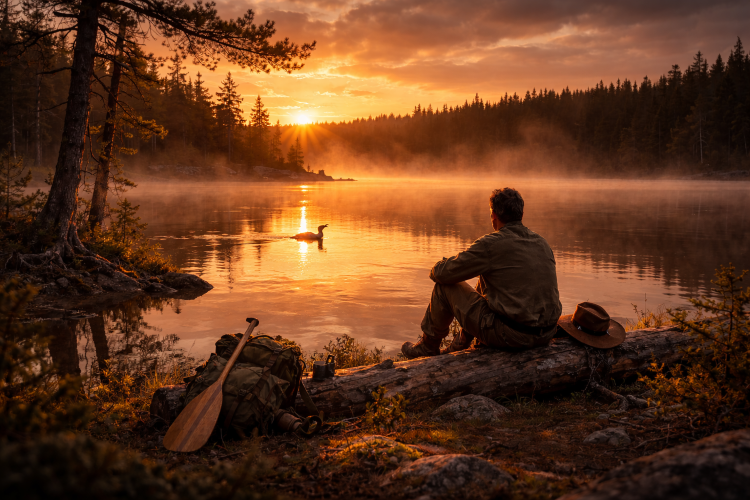
On the third evening, we camped on a small bluff overlooking a lake. I wandered away from the group and found a fallen tree that made a perfect bench. The lake was smooth as glass — no, smoother than that. A mirror. The sun was setting off to my right, reflecting in gold across the surface. A mist began to rise, turning everything sepia, then gray.
Somewhere across the water came the mournful wail of a loon.
The problems waiting for me back in Indiana felt distant that night — though I didn’t yet understand how much was already shifting beneath the surface of my life.
I woke the next morning to heavy dew soaking the tent flap and running down the back of my neck. The campfire crackled as our guide built it back up for breakfast. Everything was gray, cold, and quiet. A heavy fog had settled over the lake. I could barely see across camp. Sounds felt muffled, like I was wearing earmuffs.
And then the sun began to pierce the fog.
Light filtered through the mist and glistened across the water as the first canoe pushed off. We delayed our departure to give the other group space, sipping one last cup of coffee before extinguishing our fire.
From that moment, my journal entries changed.
I stopped cursing the trip and started paying attention.
- Our guide rescuing a seagull tangled in fishing line.
- The adrenaline rush of navigating rapids that felt more like a roller coaster than a river.
- A gloomy day of rain that shrank our world to just a few yards and somehow made the forest feel more alive.
- Even Spam heated over a small fire with a Bowie knife doing triple duty as slicer, grill, and fork tasted better than it had any right to.
The river hadn’t just changed its course.
It had changed mine.
By the time we reunited with the other groups at the end of the trip, I was in love. In love with the graceful lines of a canoe’s hull. In love with reading the water. In love with feeling the pull of a current instead of fighting it.
But what I didn’t realize at the time was that I hadn’t just fallen in love with canoeing.
I had learned to listen.
Over the next thirty years, whenever my life shifted — and there were some significant shifts — I found myself near water.
Rivers became the place where noise quieted. Where scale returned. Where ego softened. Where I could sit still long enough to hear what I was avoiding everywhere else.
They became sacred before I had language for sacred.
Years later, when Carmen came into my life, she didn’t just tolerate the river. She grabbed a paddle. She leaned into the current. Rain? Let’s go. Long drive? Turn up the music. Lewis & Clark event in cold November weather? Of course.
There is something profoundly different about paddling alone versus paddling in rhythm with someone beside you. You feel it in your shoulders. In your timing. In the way the canoe tracks straight instead of wandering.
Confluence isn’t just geography.
It’s what happens when two currents find alignment.
When you read Uncharted Moments, you’ll see rivers everywhere. The Missouri. The Columbia. Quiet backwaters and roaring rapids. Places where explorers once stood. Places where we stood centuries later.
But long before Lewis and Clark, long before confluences became metaphors, there was a foggy morning on a Canadian lake.
A loon calling across still water.
A stubborn, reluctant chaperone realizing he might have been wrong.
That’s when the rivers started calling my name.
And I’ve been returning to the current ever since.
 I woke up…on my back deck…grinned sheepishly at my wife…and admitted I must have fallen asleep. “The Curse of the Black Walnut” was not the latest Indiana Jones adventure and no, I was not Harrison Ford. The pop-pop-popping was not the sound of gun fire. “The Curse of the Black Walnut” was the sound of dozens and dozens of walnuts falling from the trees and covering the ground; covering the ground where we had just spent the last four hours picking up walnuts.
 holds about 30 walnuts. Dumping those scoops into a wheelbarrow, we count 20 – 30 scoops to a load. I have lost track of the number of wheelbarrow loads I have dumped, but I am guessing it is closing in on a hundred. Do the math, THAT my friends is a LOT of walnuts.