
Shep at the Bend
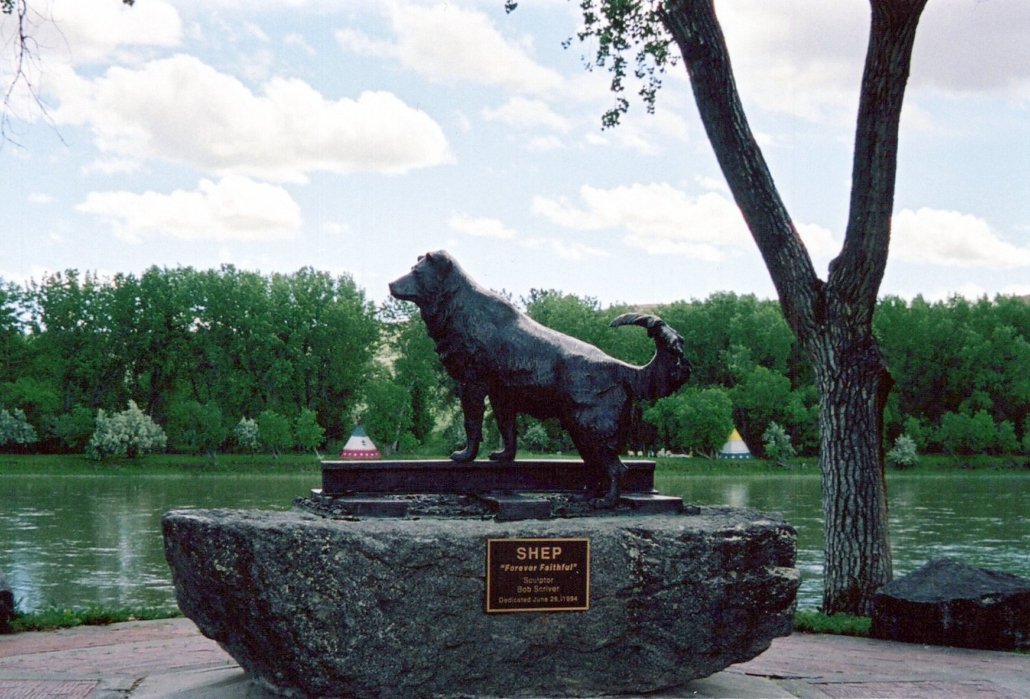
Shep – Ever Vigilant
Fort Benton wears the river like a well-earned badge. The Missouri slides past the levee with that steady, old-timer confidence—no hurry, no apology—shouldering stories you can feel even if you can’t name them. We parked, stretched road miles out of our backs, and did what we always do when we arrive anywhere along the trail: we listened. Not just with our ears, but with that other sense you learn on the water—the one that asks, What happened here, and who’s still holding the memory?
You don’t have to look far in Fort Benton. The brick storefronts, the iron bridge, the museum signs—they all point to lives stacked over lives. And there, near the river, is the town’s quiet heartbeat cast in bronze: Shep. Head lifted, ears set to a frequency I swear you can almost hear if you stand there long enough. The statue is beautiful, yes, but more than that, it’s attentive. It watches the place like a promise.
We learned the story—most visitors do—a dog and a depot. Loyalty stretched across too many days. Waiting that outlived an answer. Even if you only catch it in passing, the story tugs something in you that’s older than words. But that afternoon, the pull landed somewhere personal I hadn’t noticed before.
We read the plaque, circled the statue, and let the river do its slow work. The trick with places like this is to resist the urge to rush. You let your mind walk past the easy facts and settle into the grain. And in that space, Shep became less a legend and more a lens. Who’s keeping watch while we cross? Who’s marking the thresholds we don’t even recognize as thresholds until we’re on the other side?
A Second Shep
Back home, weeks later, I wrote the Fort Benton pages. I tried to capture the light on the water and the way that bronze posture lifted the afternoon into something like prayer. I tucked the scene among the rest of Leg 8—the miles, the small talk, the way a town on a river is never just a town. Then I slid the draft to Carmen.
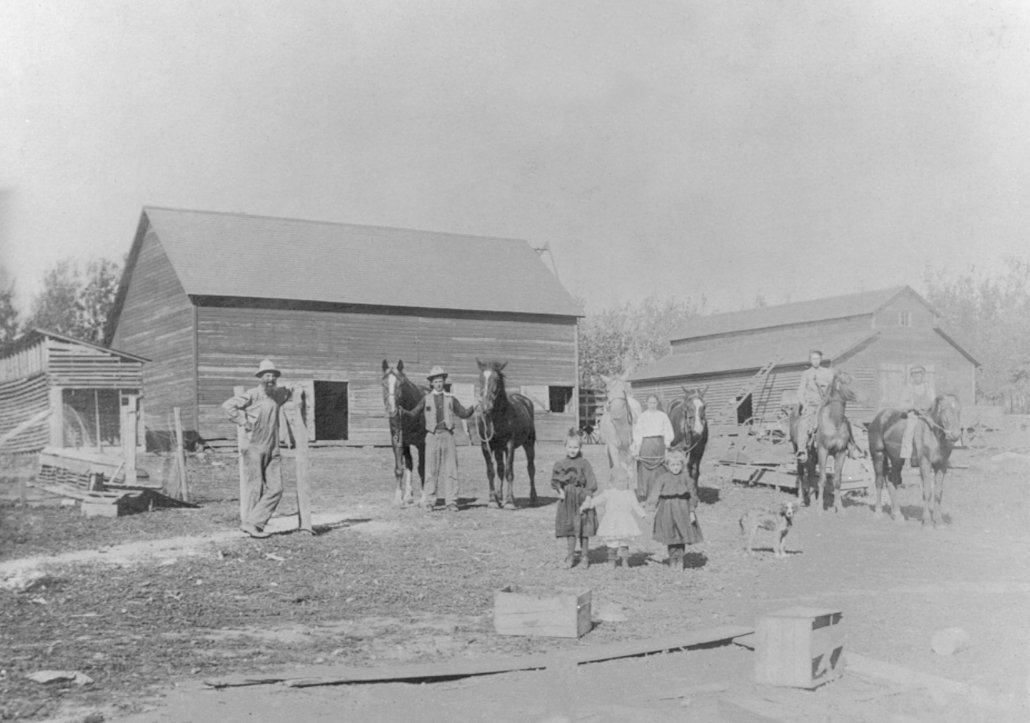
Hickey Family circa 1909 – Shep Front Right
Carmen proofreads like a cartographer—pencil steady, eyes tuned to terrain. She loves me enough to circle what’s true and underline what needs another pass. She also listens for echoes I miss. She was a few pages in when she looked up, soft smile, head cocked just a hair.
“You know your Granny’s dog was named Shep, too… right?”
The room did that slow-focus thing. I could hear the pencil roll to a stop. “What?”
“Your Granny’s farm dog,” she said, like we were both standing there in the yard already, like we’d just heard the back porch screen door slap. “Shep—it’s in her journals.”
There it was. Two Sheps, one in bronze beside the Missouri and one running fencerows in stories I grew up hearing without really hearing. A simple name becomes a through-line you can trace with your finger across a map of years. You think you’ve written a scene about a statue, and it turns out you’ve been writing about keeping watch your whole life.
I can see him now in the mind’s film—my Granny’s Shep—tan, with a white face blur at the edge of chores, tail sweeping the dust of a long afternoon. Whistle and he comes. Whisper and he hears. That’s what a shepherd does, even on a farm nowhere near a flock: he tends the threshold. He tells you when a stranger is coming up the lane. He walks with you to the barn at dusk and back to the house in the blue wash of evening. He is presence in motion.
Presence
And that’s what Fort Benton’s Shep felt like to me: presence. Not just the story tourists trade on the levee, but the way a place remembers for you when you’ve forgotten. The statue doesn’t just honor a singular dog; it blesses the job all guardians have—human or canine, living or gone—to stand at the crossings and keep an eye on us as we pass.
Carmen has always been the one to catch these threads. She did it in Paris when a bell peal turned “just friends” into something is happening. She did it in Louisville, at Mulberry Hill, when a small chain-link fence around forgotten graves felt louder than the big history down the road. She does it daily in our living room with a pencil poised over my prose. She doesn’t preach; she notices. Then she hands me the noticing like a found coin: This matters. Don’t walk past it.
Her Shep comment sent me back to the manuscript. I didn’t rewrite the scene so much as I recalibrated the listening. The river was still there, the afternoon still shouldered the same light, but the center of gravity had shifted. The statue wasn’t simply a point of interest on a Lewis & Clark-ish road day. It was an icon for a vocation that keeps finding us: stewarding what’s sacred as we move.
Sacred, for me, is not a word trapped in stained glass. It’s the living room where my grandmother’s stories breathe. It’s a town that builds bronze to say, We remember. It’s the Missouri’s hush beside a levee that has seen more arrivals and departures than any ledger can hold. It’s Carmen connecting dots I didn’t connect and, in doing so, knitting past to present so the cloth won’t tear.
If you’ve traveled with us in Uncharted Moments, you know we chase big landscapes and find small mercies. We go looking for history and discover our own hearts leaving breadcrumbs. Fort Benton gave us Shep twice—once in metal and once in memory—and both times as a gentle nudge: Pay attention at the edges. That’s where crossings announce themselves. That’s where love does its quietest, bravest work.
Thresholds
I’ve been thinking about thresholds a lot lately. The obvious ones—weddings, funerals, new jobs, last days—carry rituals we recognize. But the smaller ones shape us just as surely: a pause before you say the hard thing, a glance across a room that says we’re okay, a pencil mark in a margin that turns a “nice detail” into a seam you can pull. Maybe that’s why Shep lands so deep. He stands there without fanfare and makes the ordinary act of going from one place to another feel witnessed.
I don’t know what threshold you’re approaching. A decision you’ve been delaying. A phone call. A goodbye you didn’t choose. If I could hand you anything from Fort Benton, it would be the sense that you don’t have to cross alone. Somewhere nearby, there’s a keeper of the bend—someone or something that will sit within sight and wait until you’re on your way. Sometimes it looks like a bronze dog by a river. Sometimes it looks like a memory you thought you’d misplaced until your person says, Hey, remember? And sometimes it looks like the river itself, patient as breath.
When we left the levee, I turned once more to the statue and gave a small nod, the kind you give to an usher who helped you find your seat. Back in the car, Carmen squeezed my hand and returned to the pages. I drove with the Missouri in the corner of my eye, thinking about Granny, about dogs named Shep, about all the watchers who’ve kept vigil while we figured out our way.
We call them Uncharted Moments, these little collisions of place and past, because you can’t plan them and you can’t force them. You can only be there when they arrive. And when they do, you mark the spot—on a map, in a book, in your bones—and you carry on, shepherded by love toward whatever’s next.
— Jeff
P.S. Over the next few months, I will be sharing more from my upcoming book, Uncharted Moments Along the Lewis and Clark Trail – A Love Story. If you want to be in the know as it proceeds through the publishing process, sign up for my newsletter in the side panel of this page!
Beautiful, as usual. A poet whose words stich together people and places.